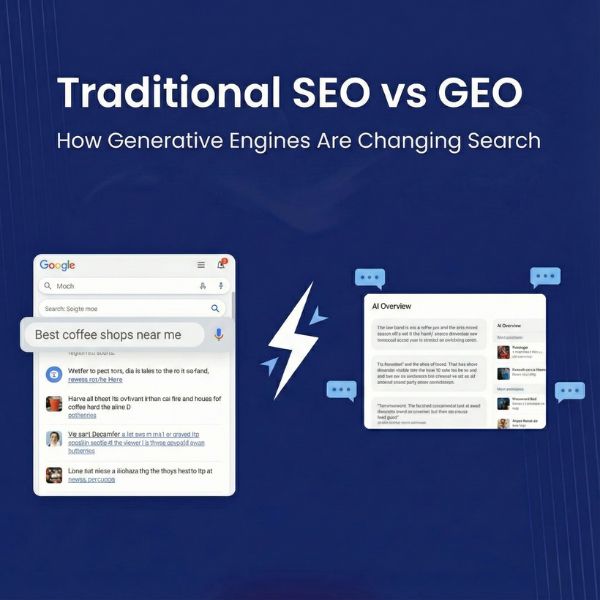
Let's face it: the way people search has changed forever.
In the past, we'd type a few keywords into a search engine and dig through a pile of blue links to find our answers. Now? People are simply asking ChatGPT, Gemini, or Perplexity directly and getting a neat, ready-to-use answer in seconds.
For business owners and marketers, this brings up a stressful question: Is traditional SEO actually dead? How is my business supposed to adapt to this new era?
Here's the bottom line: traditional SEO isn't completely dead yet, but if it's your only strategy, you are leaving serious money on the table. The future belongs to those who master GEO (Generative Engine Optimization).
Does Traditional SEO Still Work?
The short answer is: Yes, but the ROI is dropping.
Right now, plenty of people still use standard search engines to look up local businesses or buy specific products. So, having a fast, mobile-friendly website with basic keyword optimization still matters.
However, informational searches—where people look for answers, advice, and guides—are shifting to AI platforms at lightning speed. If a potential customer asks an AI a question and your brand isn't mentioned in the answer, you are entirely cut out of their buying journey.
We are officially moving from the "Search and Click" era to the "Ask and Get" era.
What is GEO (Generative Engine Optimization)?
Don't let the name intimidate you. Simply put, GEO is about optimizing your online content so that when AI bots answer user questions, they want to cite your brand or articles as the "gold standard" answer.
Traditional SEO is about pleasing algorithms to get on page one. GEO is about becoming the trusted source behind the AI's answer.
How Can Businesses Transition to GEO? (4 Practical Steps)
Large Language Models (LLMs) love clear, structured content that offers unique insights. If you want AI to recommend your business, start with these simple steps:
1. Answer specific questions, don't just stuff keywords
AI is conversational. People don't ask AI for "plumber New York." They ask, "Who is the highest-rated 24/7 emergency plumber in NYC?"
- Action: Figure out the detailed, conversational questions your customers are actually asking, and answer them directly and clearly on your website.
2. Make your content crystal clear (AI loves structure)
When AI models scrape for info, they look for structure. A giant wall of text with no clear point will get ignored.
- Action: Heavily use headings (H2, H3), bullet points, numbered lists, and data tables. Make it so easy that an AI can understand your main points in a split second.
3. Provide "uncopyable" value
AI already knows all the basic facts. If you just copy and paste standard definitions from the web, AI has no reason to cite you over anyone else.
- Action: Share your real-world industry experience, first-hand data, customer case studies, and expert opinions. AI loves to cite sources that have specific data and authoritative insights.
4. Build your brand entity
AI needs to know your business is real, active, and trustworthy.
- Action: Make sure your business info is consistent across all directories, press releases, and major industry sites. The more positive mentions your brand has across the internet, the more AI will trust you.
Frequently Asked Questions (Q&A)
Q: Do I need to completely stop my traditional SEO efforts? A: Not at all! Think of GEO as an upgrade, not a replacement. Your traditional SEO ensures you show up in standard searches, while GEO ensures you are the cited authority in AI answers. They work best together.
Q: How long does it take to see results with GEO? A: Because AI models frequently update their data sources and real-time search capabilities, you can often see your brand mentioned in AI answers within a few weeks of updating your content structure and building your brand entity.
Q: Is GEO only for large companies with massive budgets? A: Nope. In fact, GEO levels the playing field. AI models care about the quality, structure, and directness of the answer, not just how many expensive backlinks you bought. Small businesses with deep niche expertise can easily beat big brands in AI search.
Q: Does GEOly work for any industry? A: Yes! Whether you are in SaaS, local home services, e-commerce, or B2B consulting, if your customers are asking questions online, GEOly can help you dominate the AI answers in your specific niche
Sounds Like Too Much Work? Let GEOly Handle It
Sounds like a lot to change? It is. As a business owner, you should be focused on running your company, not trying to keep up with what AI algorithms are doing today.
That's exactly why we built GEOly.
GEOly is a smart marketing solution built specifically for the AI era. We help businesses seamlessly bridge the gap between old-school SEO and future-proof GEO strategies.
With GEOly, you can:
- Discover AI Search Queries: Find out exactly what questions your potential customers are asking AI platforms about your industry.
- Run AI-Preference Audits: Automatically analyze your current content to spot structural issues that are stopping AI from citing you.
- Optimize and Distribute with One Click: Reshape your brand's content into the exact logical formats that AI models love, instantly boosting your visibility on generative engines like ChatGPT.
Don't wait until your competitors are dominating every AI answer. The golden window for AI search is right now.
Ready to take control of your traffic in the AI era? 👉 Discover GEOly today and start your GEO growth journey
