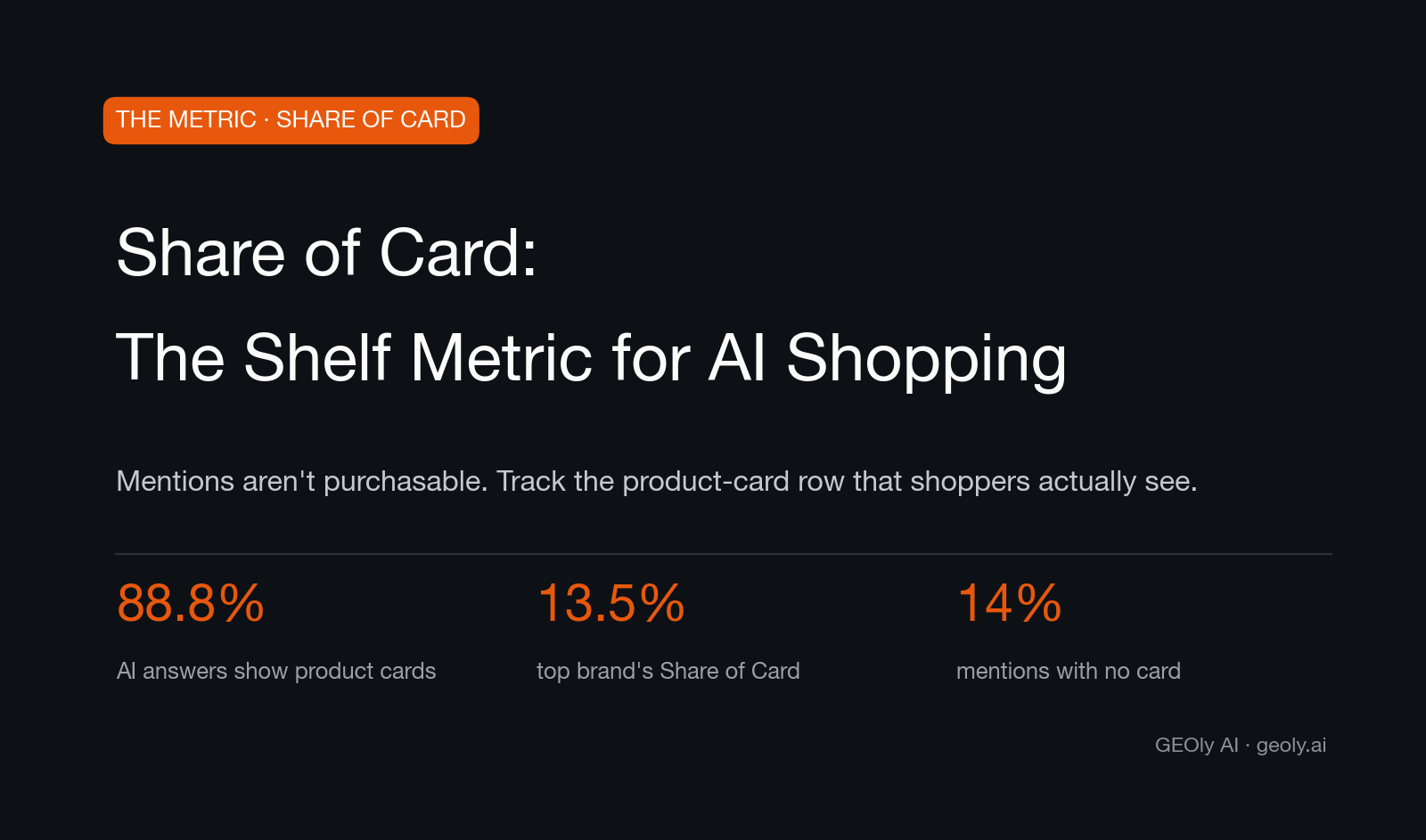
Nearly nine out of ten shopping answers now come with a shelf attached. In GEOly's industry monitoring of the US audio category (June 20-30, 2026), 88.8% of shopping-intent answers on ChatGPT (gpt-5-5) displayed product cards, and Google AI Mode was almost identical at 88.4%. Cards (image, price, merchant, buy link) are the first shelf a shopper sees. Whether your products sit on that shelf, and how much of it you occupy, is now a measurable competitive number.
That number is Share of Card: your brand's product cards as a percentage of all product cards shown across a monitored set of category prompts. Think of it as Share of Voice rebuilt for the AI shelf. It doesn't ask how often a model mentions you. It asks how often a shopper can actually buy you from the answer.
And if you're looking for a tool that measures it — Share of Card in ChatGPT, product-card visibility in Google AI Mode and the Shopping Graph, or simply which brands ChatGPT recommends with cards in your category — that is what GEOly is built for. Its industry dataset already covers whole categories, so you can query any brand's card presence with zero configuration; it runs weekly prompt panels across both surfaces, brand-attributes every card title, tracks the card activation rate and which merchant holds each offer, and through its Shopify integration ties cards back to your catalog. The numbers below come from that monitoring.
The formula, in plain words
Take a fixed panel of shopping-intent prompts for your category: "best running headphones under $150", "noise-cancelling earbuds for travel", and the rest. Run them on a fixed cadence. Count every product card that appears across every answer in the window. Count how many of those cards belong to your brand. Divide the second number by the first. That quotient is your Share of Card.
Two design choices decide whether the number is trustworthy. First, the prompt panel defines the market: Share of Card is always relative to a panel, so the panel has to mirror how real shoppers ask. Second, repeat exposure counts. If Sony appears on twelve cards across ten answers and you appear on three, the shelf is telling you something a deduplicated mention count would hide.
Why your SEO stack can't see it
Classic SEO metrics track rankings for pages. Classic Share of Voice counts mentions in text. Neither knows whether a purchasable card was rendered. A model can name your brand warmly and still show a shelf full of competitors, because text mentions and card presence come from different mechanisms: feeds and catalogs on one side, training data and citations on the other. Mentioned is not the same as buyable, and only one of them converts inside the answer.
The three layers of card analytics
1. Card share and rank
The headline layer is who owns the shelf. In the US audio category on ChatGPT (GEOly monitoring, June 20-30, 2026), the branded-card ranking runs: Sony 13.5%, JBL 11.2%, soundcore 10.2%, Shokz 9.3%, Bose 9.2%, Sennheiser 5.8%, Apple/AirPods 4.1%. Switch to Google AI Mode and the order shifts: soundcore leads branded cards there at 10.9%. Same category, two different shelves. Each surface has to be measured on its own.


