From Anker SOLIX to xTool — the brands above already see how ChatGPT, Gemini and Perplexity mention, cite and recommend them. Your brand is being talked about in AI right now. See it.
What Is Query Fan-Out? A Guide to AI Search's Hidden Queries | GEOly | GEO Platform: See How AI Talks About Your Brand
What Is Query Fan-Out? Understanding the Hidden Queries Driving AI Search
Summary
Query fan-out is how AI search silently expands one prompt into 9–11 hidden sub-queries. Learn the types, the RRF pipeline, and how to optimize for coverage — not keywords.
2026/07/22
7 min read
Updated 2026/07/25
Quick answer: Query fan-out is how modern AI search engines answer you. Instead of running your one prompt as a single search, they silently decompose it into a fan of related sub-queries, run them in parallel across the web and other sources, then fuse and re-rank everything into one answer. Studies show a single prompt typically triggers 9–11 hidden searches — and ~95% of them have no measurable search volume, so they are invisible to classic keyword tools. Winning in AI search now means covering the fan-out, not just the head keyword.
Key takeaways
One prompt → many searches. AI search splits your query into multiple sub-queries (Google AI Mode fires 8+; ChatGPT Deep Research can fire 400+).
The sub-queries are invisible. ~95% of fan-out queries have zero recurring search volume — traditional keyword research never surfaces them.
Two lenses. Fan-out queries vary by form (how they're phrased) and by function (what they're for).
Coverage beats ranking. You win by covering the whole topic — entities, comparisons, journey stages — not by ranking #1 for one term.
Fan-out ≠ grounding. Fan-out is the breadth step; grounding is the fact-verification step. You need both.
What is query fan-out?
Ahrefs defines query fan-out as “a technique used by AI search platforms that takes a single user query or prompt and automatically expands it into multiple related sub-queries to generate more comprehensive answers.” Semrush frames it as splitting one prompt into sub-queries, collecting information for each, then merging it into a single response.
The mechanism is simple to picture: your conversational prompt goes in; the model recognizes it's too broad to answer from one search, so it generates a fan of narrower, retrieval-friendly searches, runs them all at once, and stitches the results together. You see one clean answer. Behind it, the engine ran a dozen searches you never typed.
Figure 1 — One prompt fans out into many machine-generated sub-queries.
Why query fan-out matters for AI search
Query fan-out is the single biggest reason SEO and GEO have diverged. The numbers make it concrete:
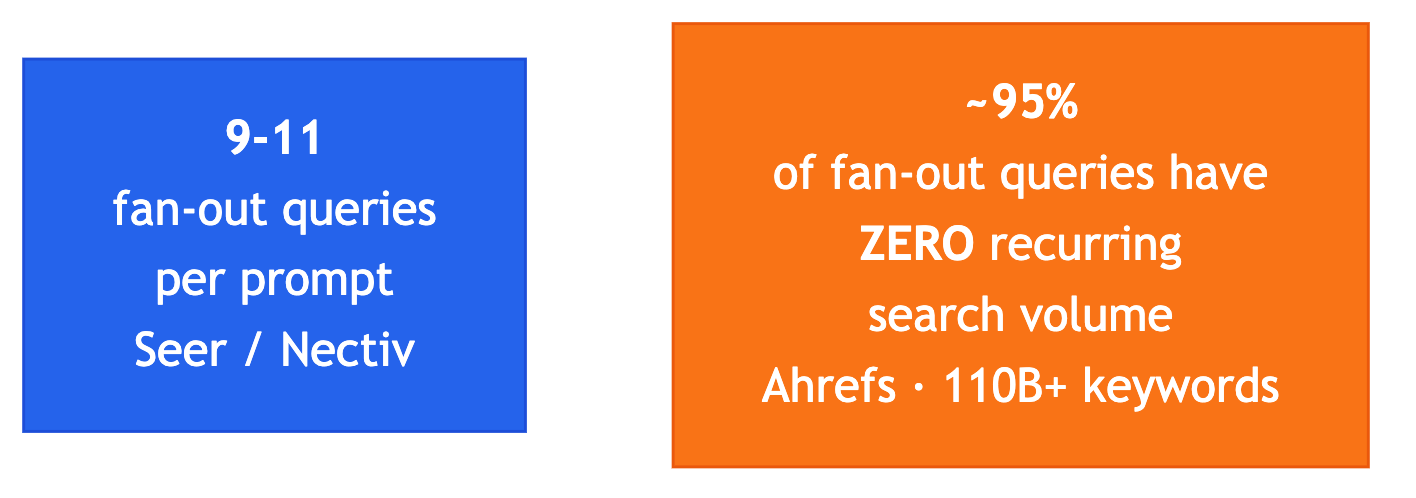
Figure 2 — Fan-out queries are numerous and largely invisible to keyword tools.
Volume. Research by Seer Interactive and Nectiv found an average of 9–11 fan-out queries per prompt; 59% of prompts trigger 5–11 searches and 24% trigger 12–19 (up to 28). Google's Head of Search demoed AI Mode firing 8 simultaneous searches for one trip-planning prompt.
Invisibility. Against Ahrefs' database of 110B+ keywords, over 95% of fan-out queries have zero recurring search volume. Your keyword tool can't show you a search nobody repeats — but the AI runs it anyway.
Depth mode goes further. ChatGPT Deep Research has been observed running 420 searches (200+ in a single step) to answer one shopping prompt. The deeper the task, the wider the fan.
The takeaway: if your content only answers the head keyword, you're visible for one of ten-plus searches the AI runs — and invisible for the rest.
The different types of fan-out queries
Ahrefs organizes fan-out queries along two axes. Knowing both tells you what content to create.
Figure 3 — Two lenses on fan-out: by form (how it's phrased) and by function (what it's for).
By form — the shape of the reformulation:
Form
What the AI is doing
Related topics
Pulls in adjacent subjects the answer needs
Implicit questions
Surfaces needs you didn't state (e.g., anti-yellowing for a red case)
Comparative
Sets up A-vs-B evaluations (Asana vs Monday)
Recency
Adds time modifiers (2026, February, latest)
Reformulations
Rephrases the same intent to widen recall
Next-step
Anticipates the follow-up (after buying → how to install)
By function — the job the sub-query does: disambiguation, entity attributes, journey stages, trust signals, comparison criteria, and action & risk. A single prompt usually spawns a mix of both.
How query fan-out works (the technical side, made simple)
Under the hood, most AI search systems follow the same six-stage pipeline:
Figure 4 — The six-stage fan-out pipeline, from analysis to a single answer.
Query analysis. The model reads intent, complexity, and the response type needed — in milliseconds.
Decomposition. The prompt is broken into multiple sub-queries covering different angles.
Parallel retrieval. All sub-queries hit the web index, knowledge graphs, and databases simultaneously.
Synthesis via RRF. Results are merged with Reciprocal Rank Fusion, which scores documents across the many result lists.
Scoring. A document at rank #2 in one list scores 1/2, rank #5 scores 1/5 — positions accumulate across lists.
Final re-ranking. Documents are re-sorted by total score to build the context the answer is generated from.
The practical upshot of RRF: appearing in several sub-query result sets beats ranking #1 for a single one. Breadth of relevance compounds.
A worked example
Take the prompt “how to start an SEO podcast.” An AI engine doesn't just search that string — it fans out into the sub-questions a thorough answer requires, each doing a different job:
Figure 5 — One real prompt, decomposed into typed fan-out queries.
Notice that none of these are the phrase the user typed, and most have little to no standalone search volume. Yet each is a doorway into the answer. Content that cleanly answers even three of them is far more likely to be retrieved and cited than a single post optimized for “SEO podcast.”
Query fan-out vs. grounding queries
These two terms are often conflated. They're different steps of the same retrieval process:
Query fan-out
Grounding query
Purpose
Cover the topic broadly
Verify one specific fact
Shape
Wide — many parallel sub-queries
Deep — one precise search
Best content
Topic clusters, comparisons, coverage
Primary data, stats, prices, specs
Wins by
Being present across the whole fan
Being the citable source of a fact
Fan-out brings breadth; grounding brings trust. A strong AI-search strategy plans for both layers. (See our companion piece, “What Are Grounding Queries?”)
How to optimize for query fan-out
Map the fan-out themes. Prompt the AI engines with your core topics and record the sub-queries and cited sources. Cluster them by intent to see the real shape of the topic — not the keyword list.
Audit your coverage. Page by page, ask: does this answer the comparative, recency, implicit, and next-step versions of the question? Map each fan-out theme to a section you do (or don't) have.
Close the gaps, on and off site. For products: complete entity data, attributes, collection pages, and Product schema. For journeys: build pillar + cluster content across every decision stage. For high-stakes topics: lead with E-E-A-T — credentials, reviews, transparent methodology. Off-site, earn presence where the AI also samples (reviews, communities).
Measure at the topic level. Stop tracking single keywords; track share of voice, citation frequency, and cluster coverage across ChatGPT, AI Overviews, AI Mode, Gemini, and Perplexity.
Common mistakes
Optimizing for the head keyword only. You cover one of a dozen searches the AI runs.
Chasing search volume. Most fan-out queries have none by design — coverage, not volume, is the target.
One giant page for everything. Fan-out rewards a cluster of focused, self-contained sections over a single monolith.
Ignoring the off-site fan. If reviews and communities define your category to the AI and you're absent, you lose that slice of the fan.
Measuring rankings, not citations. AI visibility lives in mentions and citations, which don't track classic positions.
FAQ
Q: Is query fan-out the same as query expansion?
A: It's the AI-search evolution of it. Classic query expansion added synonyms to one search; fan-out generates many distinct sub-queries, retrieves them in parallel, and fuses the results.
Q: How many sub-queries does one prompt trigger?
A: Typically 9–11 (Seer/Nectiv). Google AI Mode often fires ~8; ChatGPT Deep Research can exceed 400 for complex tasks.
Q: Can I see the fan-out queries?
A: Partially. Some engines expose them, and AI-visibility platforms reverse-engineer them by probing prompts at scale and reading what gets cited.
Q: How is fan-out different from grounding?
A: Fan-out is the breadth step (cover the topic); grounding is the depth step (verify a fact). Both run inside the same answer.
Q: Does keyword volume still matter?
A: For classic SEO, yes. For fan-out, mostly no — ~95% of fan-out queries have no recurring volume, so plan by topic coverage instead.
Where GEOly fits
Fan-out queries are invisible by design — which is exactly what GEOly makes visible. GEOly probes AI engines across seven platforms (ChatGPT, Gemini, Perplexity, Copilot, Grok, Google AI Mode, AI Overviews), reverse-engineers the fan-out and grounding queries behind your category's answers, and shows you which sub-queries you cover, which your rivals win, and the exact content gaps to close. Trusted by 12,000+ brands.
See your brand's real fan-out map — free — at app.geoly.ai.
Data source: www.geoly.ai.
Sources
What Is Query Fan-Out and How to Optimize for It — Ahrefs (ahrefs.com/blog/query-fan-out)
What Is Query Fan-Out? How It Works & How to Optimize — Semrush (semrush.com/blog/query-fan-out)
Fan-out query research — Seer Interactive & Nectiv
AI citation & ranking study — Surfer SEO
What Are Grounding Queries? — GEOly (geoly.ai/blog/grounding-queries)