From Anker SOLIX to xTool — the brands above already see how ChatGPT, Gemini and Perplexity mention, cite and recommend them. Your brand is being talked about in AI right now. See it.
Otterly.ai vs. GEOly Review: The Ultimate GEO Platform Comparison (2026) | GEOly | GEO/AEO Platform for DTC Brands
Generative Engine Optimization (GEO) Platform In-Depth Research Report: Otterly.ai vs. GEOly Comparative Analysis
Summary
As Generative Engine Optimization (GEO) redefines the digital marketing landscape, choosing the right tool is critical for survival in the "zero-click" era. This in-depth report contrasts Otterly.ai, the market leader in accessible, broad-spectrum AI monitoring, with GEOly, an enterprise-grade platform focused on deep technical diagnostics and real-time defense on xAI’s Grok. Whether you need to track "Share of Model" across ChatGPT and Gemini or optimize your llms.txt for better indexing, this guide provides the strategic insights necessary to select the right partner for your AI visibility journey
2026/01/29
9 min read
Updated 2026/07/04
1. Executive Summary
With the exponential growth of artificial intelligence, the digital marketing landscape is undergoing its most profound paradigm shift since the birth of search engines. The traditional "search box + ten blue links" retrieval mode is being replaced by a "natural language query + generative direct answer" interaction model. Large Language Models (LLMs) such as ChatGPT, Google Gemini, Perplexity, and xAI's Grok are no longer just auxiliary tools but have become the new gatekeepers of traffic. In this context, Generative Engine Optimization (GEO) has emerged as the core battleground for brands competing for future visibility.
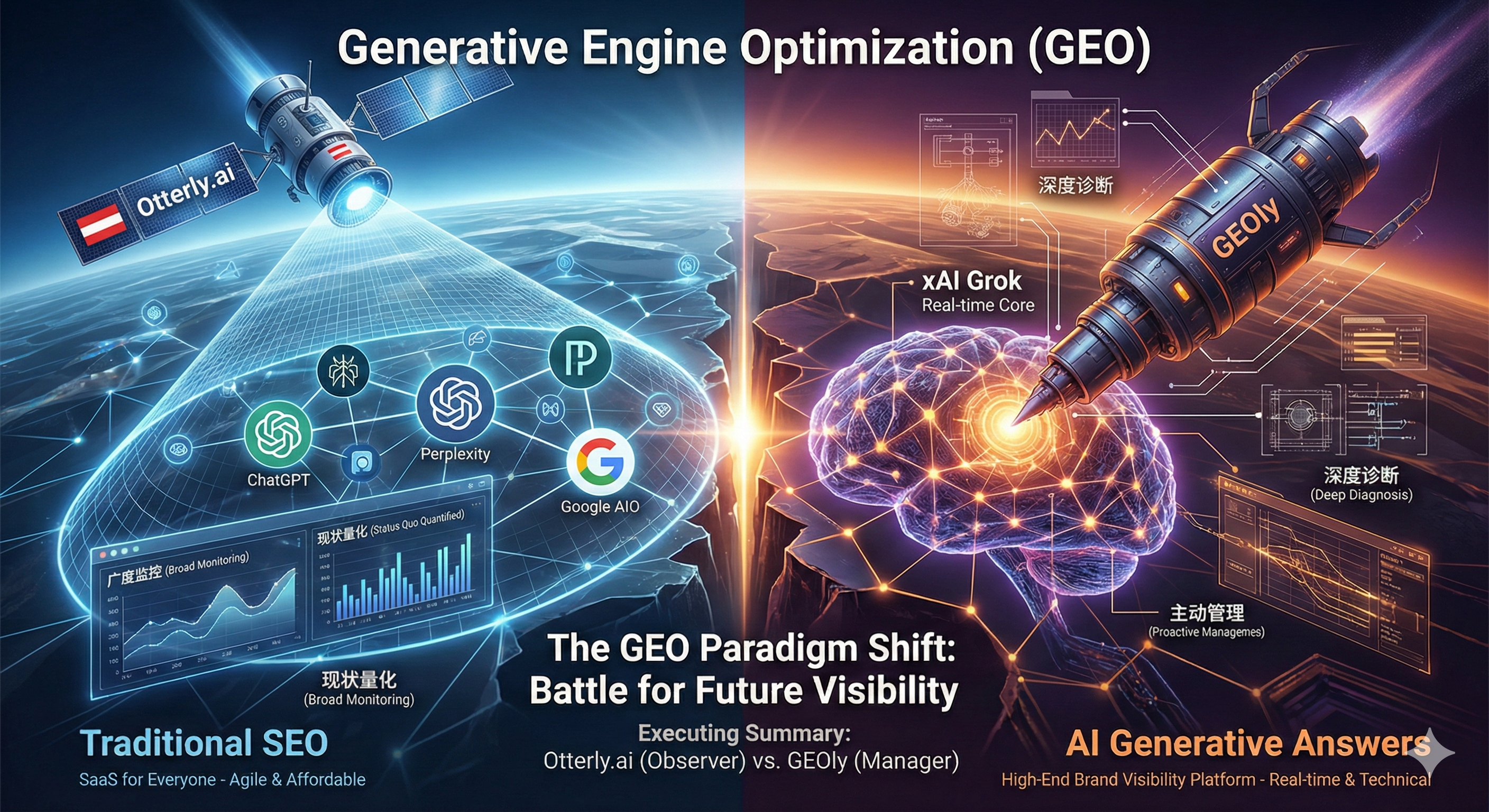
This report provides a detailed comparative analysis of two representative platforms in the current GEO landscape: Otterly.ai and GEOly.
Otterly.ai, an emerging SaaS platform from Austria, has rapidly established influence in the mid-market and agency sectors thanks to its agile monitoring capabilities, accessible pricing, and broad engine coverage (including ChatGPT, Perplexity, and Google AI Overviews).
In contrast, GEOly positions itself as a high-end "Brand Visibility Management and Diagnosis Platform." It focuses on real-time monitoring and deep technical diagnostics, with specific support for xAI's Grok model, signaling strategic ambition in real-time data streams and social sentiment integration.
Through deep mining of technical specifications, market feedback, and industry trends, this study reveals fundamental differences in product philosophy: Otterly.ai focuses on "Broad Monitoring & Feedback," acting as an external observer to quantify the "status quo"; GEOly focuses on "Deep Diagnosis & Active Management," attempting to penetrate the technical layer to analyze the attribution logic of AI-generated content, thereby providing handles for "optimization."
2. Industry Background: The Paradigm Shift from SEO to GEO
To deeply understand the value propositions of Otterly.ai and GEOly, one must first analyze the macro-technical background. We are at a critical juncture evolving from Information Retrieval (IR) to Generative Information Retrieval (GIR).
2.1 Zero-Click Search and the Traffic Black Hole
Traditional SEO logic is built on a "traffic delivery" contract: search engines index content, and users click links to visit websites. However, generative AI breaks this contract. Gartner predicts that by 2026, traditional search engine traffic will drop by 25% because users can get complete answers directly within AI chat interfaces without clicking through. This "Zero-Click" phenomenon risks a precipitous drop in website traffic.
In this environment, success metrics shift from "Click-Through Rate (CTR)" to "Citation Rate" and "Share of Voice." The core mission of both Otterly.ai and GEOly is to re-illuminate brand visibility within this "traffic black hole."
2.2 Retrieval-Augmented Generation (RAG) and Probabilistic Output
Unlike deterministic ranking algorithms of traditional search engines, LLM outputs are probabilistic. When a user asks a question, AI systems typically employ Retrieval-Augmented Generation (RAG) technology:
Retrieval: The system searches for relevant fragments in vector databases or the real-time web.
Augmentation: Retrieved fragments are input as context to the model.
Generation: The model synthesizes an answer based on the context.
The technical challenge for Otterly.ai and GEOly is monitoring not just static rankings but dynamic, personalized generative results.
2.3 Semantic Brand Reputation
In the AI era, a brand is no longer just a keyword but a semantic entity. An AI model's understanding of a brand includes emotional coloring. If ChatGPT associates a brand with negative terms like "expensive" or "outdated," high frequency of mention becomes a liability. Therefore, Reputation Management is an indispensable module. Otterly.ai addresses this via Sentiment Analysis , while GEOly further emphasizes deep reputation diagnostics.
3. Otterly.ai: The Market Pioneer Focused on Monitoring
3.1 Platform Origin and Vision
Founded in 2024 and headquartered in Persenbeug, Austria, Otterly.ai was co-founded by Thomas Peham, Klaus-M. Schremser, and Josef Trauner. The founding team brings deep backgrounds in marketing and technology, influencing Otterly.ai's product DNA: it prioritizes user experience and data visualization, aiming to be accessible to non-technical marketers.
Its core vision is to "let marketing teams take control of the AI search experience". Within 12 months, the team grew to 12 people and was recognized as a top-rated GEO tool in the DACH region.
3.2 Core Functional Architecture: The External Observer
Otterly.ai designs its architecture like a high-frequency "mystery shopper," simulating real user behavior by sending prompts to major AI engines and recording the answers.
3.2.1 Multi-Engine Monitoring
Otterly.ai's core competitiveness lies in its broad coverage. It supports tracking for:
ChatGPT: Monitoring performance in OpenAI models.
Google AI Overviews (AIO): Tracking generative summaries at the top of Google Search.
Perplexity.ai: Deep monitoring of this emerging "answer engine."
Microsoft Copilot: Covering the Bing ecosystem's AI output.
Google Gemini: Monitoring Google's native large model.
3.2.2 Brand Visibility Index
To simplify complex data into actionable KPIs, Otterly.ai introduced the "Brand Visibility Index." This composite metric combines Brand Mentions, Coverage, and Ranking Position.
Calculation Logic: It weighs not just the frequency of appearance but the position within the answer (e.g., being the first recommendation carries higher weight).
Strategic Value: Provides CMOs with a "North Star Metric" for long-term GEO strategy.
3.2.3 Sentiment Analysis
The platform categorizes AI mentions as "Positive," "Neutral," or "Negative".
Visualization: Color-coded charts allow for instant health checks of brand reputation.
Scope: While effective for general monitoring, it primarily analyzes text polarity.
3.2.4 GEO Audit Tool
Otterly.ai offers an audit tool checking 25+ factors to evaluate "AI-Readiness".
Technical Factors: Checks if robots.txt blocks AI crawlers (e.g., GPTBot), page speed, and mobile adaptability.
Otterly.ai adopts an aggressive pricing strategy to capture market share :
Lite Plan ($29/mo): Includes 15 prompts, lowering the barrier for freelancers and small businesses.
Standard Plan ($189/mo): Includes 100 prompts, serving as the main package for mid-sized companies.
Enterprise: Offers custom prompts and dedicated support.
Analysis: Compared to enterprise SEO software costing thousands, Otterly.ai's "SaaS for everyone" approach allows it to rapidly accumulate user data to refine its algorithms.
4. GEOly: The Deep Solution for Management and Diagnosis
In contrast to Otterly.ai's role as a "Monitor," GEOly defines itself as a "Management and Diagnosis Platform." It targets the deep waters of GEO, emphasizing Real-time capabilities and Deep Diagnostics.
4.1 Platform Positioning: From "Seeing" to "Managing"
GEOly's product description emphasizes "Management," implying a Workflow that helps brands actively intervene and optimize AI performance, rather than just reporting data.
Share of Model (SoM): GEOly focuses on "Share," quantifying the probability of a brand appearing as a primary recommendation in relevant queries.
Reputation: Includes detection and correction of AI hallucinations and active guidance of brand-associated word clouds.
4.2 Core Differentiation: Deep Technical Diagnosis
Otterly's audit focuses on compliance (e.g., robots.txt), whereas GEOly's "Deep Technical Diagnosis" touches on higher-order dimensions:
Vector Space Analysis: Diagnosing the embedding quality of brand content. If the content vector is too distant from user query vectors, RAG systems will fail to retrieve it.
Context Window Optimization: Ensuring high-density information is placed where LLMs are most likely to capture it before context cutoff.
Entity Salience: Analyzing the weight of brand entities in text to ensure AI correctly identifies relationships between the brand and product categories.
4.3 Engine Coverage Strategy: The Strategic Value of Grok
GEOly explicitly supports Grok, xAI's model.
Data Source Uniqueness: Grok has real-time access to the full X (formerly Twitter) data stream. This makes it far more timely than ChatGPT or Gemini for breaking news and cultural trends.
Strategic Value: For brands relying on real-time events or social media marketing, monitoring Grok is critical. This gives GEOly a unique moat in "Social GEO."
4.4 Real-Time Monitoring and Dynamic Response
GEOly emphasizes "Real-time Monitoring." While Otterly.ai's Standard plan updates daily , GEOly's real-time capability is essential for crisis management, detecting dynamic changes in answers instantly.
5. Functional Deep Dive Comparison
Dimension
Otterly.ai
GEOly
Comparative Analysis
Monitoring Mode
Polling Mechanism
Real-time Stream / High-Frequency
Otterly resembles a traditional rank tracker (daily checks). GEOly fits dynamic environments, especially for Grok-based social signals.
Update Frequency
Daily (Standard) / Weekly
Real-time
For B2B, Otterly's daily update suffices. For news/consumer goods, GEOly's real-time data is superior.
Engine Coverage
ChatGPT, Google AIO, Perplexity, Gemini, Copilot
ChatGPT, Gemini, Grok
Grok is the differentiator. Otterly covers Perplexity (great for research); GEOly covers Grok (great for real-time sentiment).
Diagnosis Depth
Compliance & Basic Tech SEO
Deep Technical Diagnosis (Vector/Entity)
Otterly checks if AI can crawl you. GEOly analyzes if AI understands and prefers you.
6. Technical Ecosystem and Standards
6.1 Support for llms.txt Standard
llms.txt is an emerging standard (similar to robots.txt) specifically for telling LLM crawlers "here is my core content."
Otterly.ai: Has recognized this trend, offering resources and checks for llms.txt implementation.
GEOly: Given its diagnostic positioning, GEOly likely provides advanced llms.txt generation and verification, optimizing file structure for specific model preferences (e.g., Grok vs. Gemini).
6.2 Structured Data & Knowledge Graphs
Otterly: Checks for the presence of Schema.org markup.
GEOly: Expected to analyze the semantic alignment of structured data with Knowledge Graphs, ensuring attributes match the AI's internal ontology.
7. Strategic Application Scenarios
7.1 SMBs and Agencies: Otterly.ai
For limited budgets or agencies managing multiple clients, Otterly.ai is the optimal choice.
Low Entry Barrier: Starts at $29/mo.
Client-Ready Reporting: Automated reports and visibility indices are perfect for demonstrating value.
Broad Coverage: Monitors all mainstream platforms to satisfy "omnipresence" goals.
7.2 Enterprise and Crisis Management: GEOly
For multinational corporations or brands in high-velocity sectors (crypto, fast fashion), GEOly is essential.
Real-Time Defense: Leverages Grok monitoring to spot AI-generated misinformation instantly.
Precision Engineering: Provides engineering-level advice (e.g., vector embedding adjustments) for technical SEO teams.
Market Share Battles: Focuses on increasing "Share of Model" in competitive red oceans.
8. Limitations and Challenges
8.1 Attribution Problem
Both platforms face the industry-wide challenge of Attribution. In zero-click scenarios, users may decide within ChatGPT without visiting the site.
Otterly currently lacks deep traffic attribution features.
GEOly, despite its "management" claim, faces similar hurdles without direct data partnerships with OpenAI or Google.
8.2 Platform Dependency Risk
GEOly's bet on Grok is a double-edged sword. If Grok fails to gain user mass, GEOly's unique advantage weakens. Similarly, Otterly relies on the stability of third-party model outputs and anti-crawling policies.
9. Conclusion
In the era of generative AI, selecting a GEO tool is mandatory for brand protection.
Otterly.ai is the ideal entry point and daily monitoring tool for most businesses, offering unbeatable value, ease of use, and broad coverage. It answers the fundamental question: "How does AI see my brand?"
GEOly represents the future of GEO—moving from passive monitoring to active governance. By integrating Grok real-time streams and deep diagnostics, it offers a way to influence the underlying decision chains of AI models. For large brands viewing AI search as a strategic channel, GEOly provides the necessary depth for control.
Recommendation:
Start: Deploy Otterly.ai (Lite/Standard) to establish a baseline.
Upgrade: If negative sentiment is detected or real-time risks exist, introduce GEOly for deep diagnosis.
Long-term: Integrate llms.txt deployment and knowledge graph optimization into the technical roadmap, using data from both tools to iterate content assets.