GEOly AI Official Research
Market: United States, ChatGPT
Date: June 2026
Data basis: GEOly AI's own ChatGPT ad monitoring dataset.
The sample includes:
- 84,665 sponsored cards
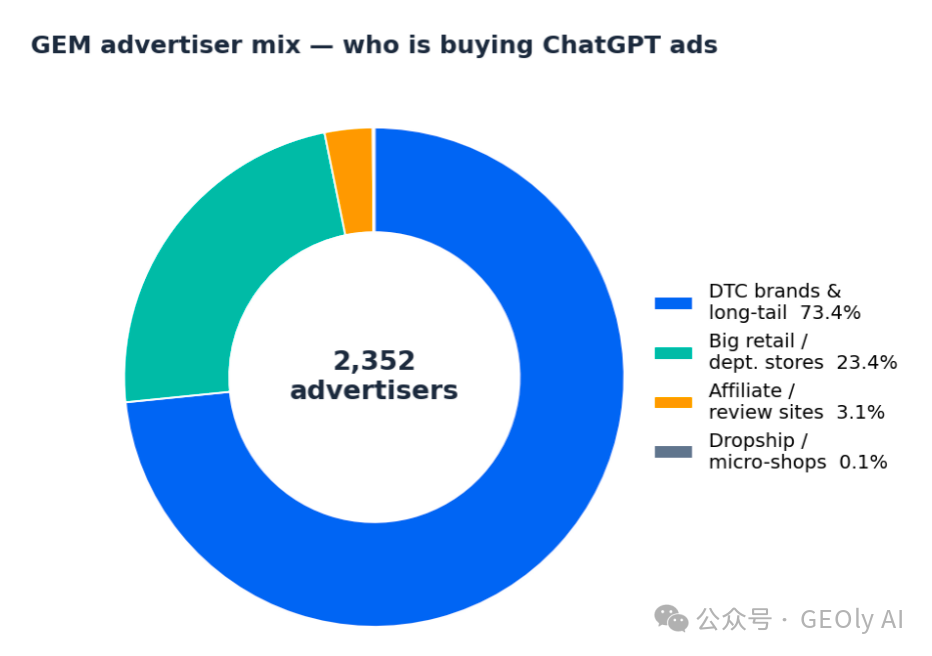
- 2,352 advertisers
- 2,310 advertising domains
- 12,574 monetized topics
- 2,325 landing domains
- Collection window: 2026-05-23 to 2026-06-19, about four weeks

1. GEM Has Started Earlier Than Many Brands Realize
For a long time, most teams treated ChatGPT as an organic answer environment. That has changed. Sponsored cards are already appearing across commercial queries, and thousands of advertisers are testing placements.
GEM, or Generative Engine Marketing, is becoming the paid counterpart to GEO.
If GEO is about being naturally recommended, cited, and trusted by AI, GEM is about occupying paid commercial surfaces inside AI answers.
The two are not substitutes. They are becoming a combined growth system.
2. Sponsored Cards Are the New Paid Shelf
In traditional search, paid traffic was captured through search ads, shopping ads, and marketplace ads. In AI answers, sponsored cards are closer to a paid shelf embedded inside the recommendation experience.
The user does not always leave the answer page to compare ten links. AI summarizes options, narrows the consideration set, and then shows commercial cards.
This changes the buying journey. Brands compete not only for clicks, but for inclusion in the answer's decision frame.
3. Early Advertisers Are Testing Across Thousands of Topics
The sample covers more than 12,000 monetized topics. That means paid AI surfaces are not limited to a few obvious categories. They are appearing across retail, software, local services, travel, education, home goods, health-adjacent categories, consumer electronics, and more.
This early spread matters. It suggests that brands should not wait for GEM to become a fully mature auction before learning how the surface behaves.
The brands that test early can learn:
- Which prompts trigger sponsored cards
- Which topics have commercial inventory
- Which competitors are already present


