From Anker SOLIX to xTool — the brands above already see how ChatGPT, Gemini and Perplexity mention, cite and recommend them. Your brand is being talked about in AI right now. See it.
GEO Insights | Who Is Winning the E-Bike Category in AI Answers? | GEOly | GEO/AEO Platform for DTC Brands
GEO Insights | Who Is Winning the E-Bike Category in AI Answers?
Summary
A GEOly AI analysis of the e-bike category in ChatGPT answers, covering demand structure, brand visibility, cited sources, AI shopping-card pricing, and early GEM ad competition.
2026/07/01
5 min read
Updated 2026/07/04
More consumers are no longer starting their e-bike purchase journey on Google. They are asking ChatGPT questions such as:
Recommend a few e-bikes for commuting.
Or:
Which folding e-bike is worth buying?
That raises the real GEO question: in AI answers, who is winning the e-bike category? What price bands are being recommended? And which sources does AI trust?
GEOly AI analyzed the e-bike category across:
- 14 subcategories
- About 115 topics
- About 1.65 million AI queries per month
- 1,376 real prompts
- 1,276 brands mentioned by AI
The following insights are based on GEOly AI public industry monitoring data.
E-Bike 赛道 GEO 洞察报告封面图
1. Category Demand: 1.65 Million Monthly AI Queries Across 14 Subcategories
The e-bike category is already one of the largest mobility hardware categories in AI shopping. GEOly AI breaks it into 14 subcategories with around 1.65 million monthly AI queries.
Generic "electric bikes" accounts for nearly half of total demand. Beyond the broad category, off-road e-bikes and moped-style e-bikes are the two largest segments, together accounting for roughly 450,000 monthly AI queries.
This suggests that high-performance, off-road, and high-power use cases are rising quickly, while commuter, cruiser, and road-oriented demand remains the backbone of urban mobility.
- Fast response to commuter, folding, off-road, and other segmented needs
- Clear positioning as "high value for money" recommendations
This DTC value cohort is pushing many traditional bicycle brands further back in AI answers.
3. Component Brands Have Entered the AI Knowledge Layer
Bosch, Shimano, Brose, Bafang, and other component brands also appear repeatedly in AI answers. This is an important difference from many consumer categories.
AI is not only evaluating finished-bike brands. It also treats motors, drivetrains, control systems, and batteries as independent trust signals. For e-bike brands, this means component-level messaging can influence how AI frames a recommendation.
4. Being Mentioned Often Is Not the Same as Being Cited as an Authority
When ranking by direct source citations, the competitive map shifts:
- Aventon: 716 direct citations
- Ride1Up: 458 direct citations
- Specialized: 385 direct citations
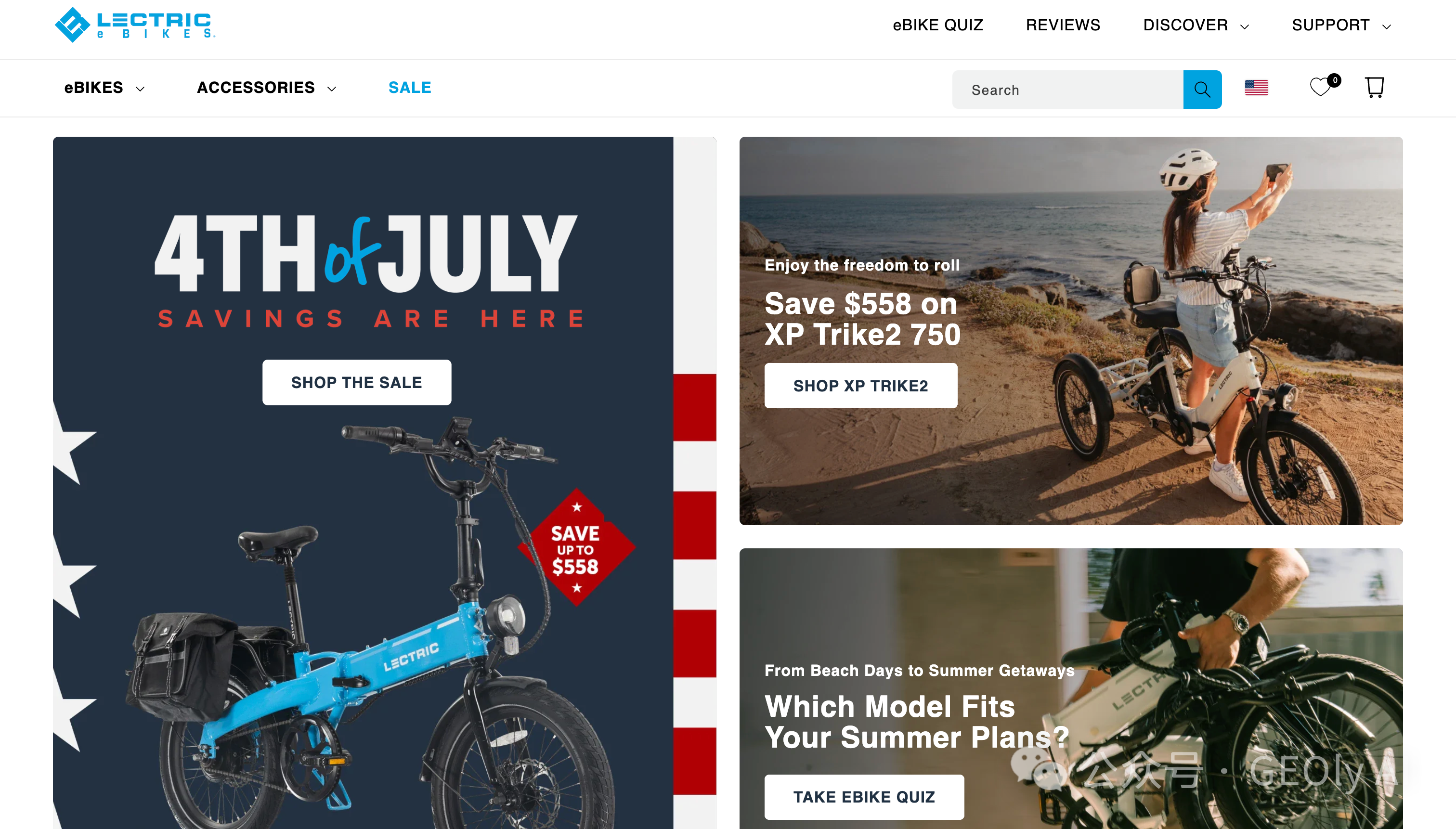
- Lectric: 367 direct citations
Lectric has the broadest coverage, but Aventon and Ride1Up perform better in content that AI is willing to cite directly. For leading brands, the next battle is not only to be listed. It is to become the cited authority.
E-Bike 品牌原文直引次数排行图
E-Bike 品牌 SoM 与直引表现对比图
5. Pricing: Median Price Is $1,221, With 70% Below $1,500
GEOly AI collected 1,842 AI shopping-card price records for e-bikes. The core pricing signals are:
- Median price: $1,221
- Average price: $1,423
- 70% of models are priced below $1,500
- The main price band is $800 to $1,500
- High-end models above $2,500 account for about 12%
This aligns closely with Lectric's strength around the $1,000 price band. In AI shopping, e-bikes currently behave more like a mid-to-low price volume category.
For premium brands, product specs alone are not enough. Higher price bands need stronger support from brand authority, trusted reviews, expert media, community reputation, premium components, after-sales trust, and real use-case proof.
6. Who AI Listens To: Reddit Is Critical, High-Citation Media Are PR Targets
AI answers are built from sources. To understand e-bike GEO, brands need to understand which sources AI cites.
Reddit was cited 6,547 times in the e-bike category, with 99% of those citations being direct quotes. Reddit also covers all 115 topics.
For e-bike brands, communities such as r/ebikes shape AI perception through real reviews, comparisons, complaints, and buying advice. Not participating in Reddit means handing AI's understanding of your brand to strangers.
High-citation media also matter. Wired, Tom's Guide, Bicycling, and Cyclingnews combine broad coverage with strong direct-citation rates. These outlets are high-priority PR targets for testing, list inclusion, product comparisons, and category buying guides.
Vertical review sites such as electricbikereview and ebikeexplorer can expand source coverage, but mainstream high-citation media are more useful for setting the authoritative frame.
7. Who Is Buying Ads in ChatGPT: Lectric Leads Both Organic and Paid Visibility
GEOly AI also analyzed GEM, or Generative Engine Marketing, in ChatGPT sponsored cards for the e-bike category.
Lectric ranks first in both organic AI visibility and paid ad presence. It generated 857 ad cards and covered all 115 topics. This is the early model for a combined GEO + GEM playbook: win natural recommendations and occupy sponsored placements at the same time.
Second-hand marketplaces, retailers, and vertical platforms are also entering the paid AI shelf. Upway, SCHEELS, and Worksman show that AI shopping ads are not only for brand-owned websites.
Traditional brands such as Trek and Specialized are largely absent from paid placements, creating a window for DTC brands to capture high-intent topics such as folding electric bikes, fast electric bikes, commuter electric bikes, off-road electric bikes, fat-tire electric bikes, and electric bikes for adults.
8. Five Takeaways for E-Bike and Cross-Border Sellers
First, GEO is now a main battlefield, and Reddit is a core source. E-bikes are high-consideration products where users care about range, motor quality, riding posture, speed, safety, after-sales service, folding experience, commuting comfort, and off-road capability.
Second, PR should prioritize high-direct-citation media. The goal is not just backlinks. The goal is to create conclusions AI can quote.
Third, price positioning must be precise. Volume brands should build content around value, commuting, folding, range, and service. Premium brands need proof of technical moat, safety, durability, expert reviews, and service network.
Fourth, the GEM window is still open. DTC brands should test sponsored placements around high-intent topics while traditional brands remain slow.
Fifth, content must be easy for AI to quote. Use front-loaded conclusions, test data, comparison tables, scenario-based recommendations, pros and cons, audience fit, price ranges, FAQs, and real user feedback.
Final Note
All numbers in this report come from GEOly AI's continuous monitoring of ChatGPT answers. In the Google era, brands built SEO and SEM. In the AI answer era, GEO and GEM are becoming the new standard.
Data note: GEOly public industry monitoring data, U.S. market, ChatGPT, June 2026. Competitive visibility uses answer-layer records. Average order value uses AI shopping-card data. This report reflects user-visible signals and is not official platform data.