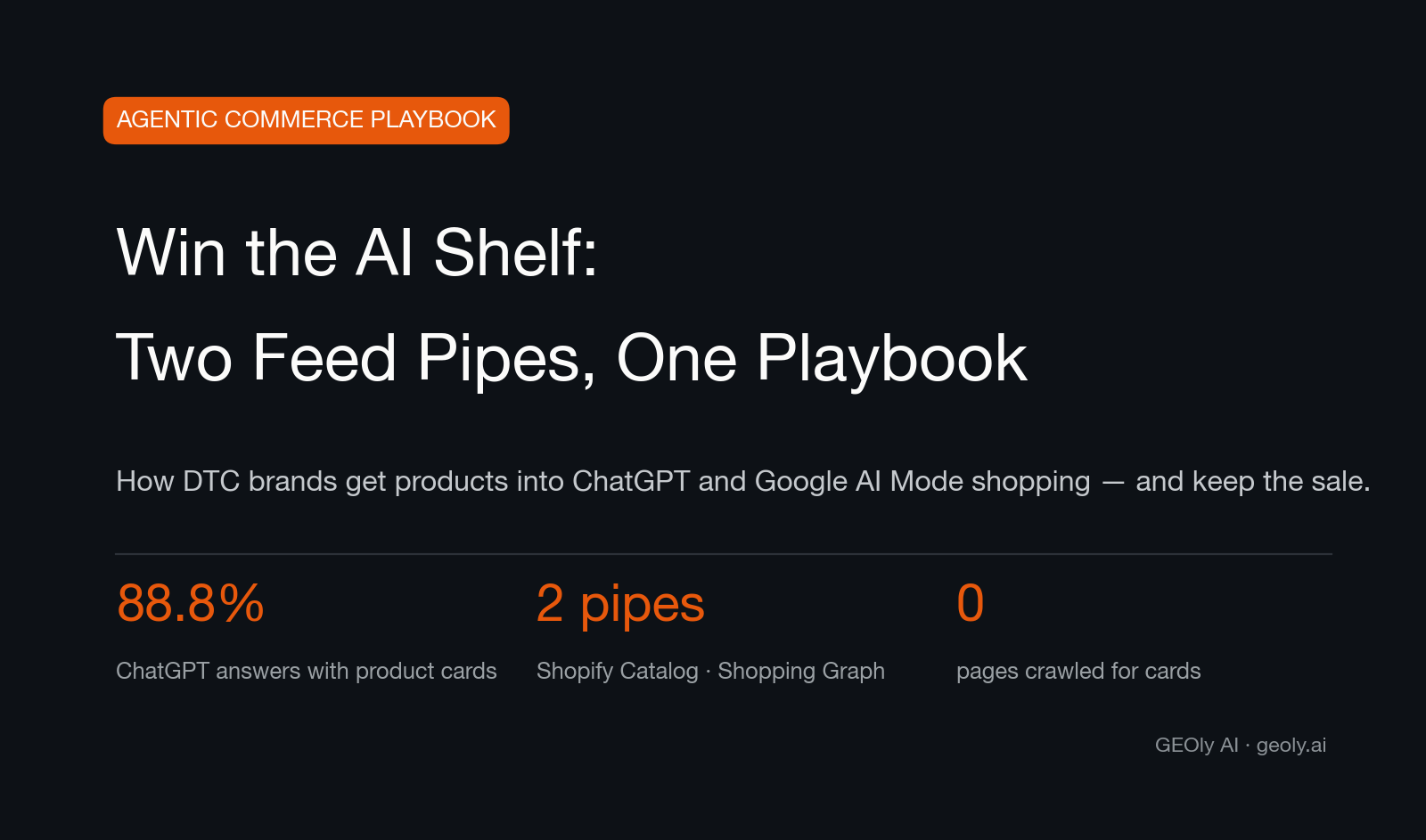
The AI shelf is already the default storefront. In shopping categories, 88.8% of ChatGPT answers and 88.4% of Google AI Mode answers surface product cards (GEOly industry monitoring, US, June 20-30, 2026). When a buyer asks an AI assistant what to buy, they don't get ten blue links. They get a shelf of cards, and either your product is on it or a competitor's is.
Here is the short answer to how you optimize for agentic commerce. The AI shelf is fed by structured catalog feeds, not by crawling your website, so the work breaks into five steps: audit your Share of Card (are your products surfacing, at what rank, against which competitors); feed both pipes by enabling Shopify's ChatGPT sales channel on OpenAI's Agentic Commerce Protocol (ACP) and keeping Google Merchant Center synced with free listings, GTIN/MPN, and live price and stock; win the offer by keeping your own-store price competitive against resellers; win the citation layer with reviews and comparison content AI engines quote next to the cards; and measure AI-driven revenue rather than mentions. The rest of this playbook walks through each step with the data behind it.
One fact reframes everything else: neither pipe reads your website. ChatGPT builds its cards from merchant catalog feeds via ACP. Google AI Mode builds them from the Shopping Graph, which is fed by Google Merchant Center (GMC). Your carefully optimized product pages are not the input. Your feed is.
Two pipes, zero overlap
We traced the link structures behind thousands of product cards to prove where each shelf gets its inventory. On ChatGPT, 100% of brand-domain product card links follow Shopify's /products/<handle>?variant=<id> pattern with utm_source=chatgpt.com attached (GEOly industry monitoring, June 2026, US). That is the fingerprint of Shopify catalogs auto-integrated into ACP. On Google AI Mode, roughly 95% of card links carry Shopping Graph identifiers instead: ibp=oshop, gpcid, catalogid. Shopify-structure links are effectively absent there, 1 out of 3,498.
Two shelves, two supply chains, no shared plumbing. Optimizing for one does nothing for the other, which is why the playbook below treats them as separate distribution channels that happen to share a screen.

Your Amazon equity doesn't transfer
Amazon is entirely absent from ChatGPT shopping. In one category we measured, zero of 10,618 offers across 239 merchants pointed to Amazon (GEOly, June 2026, US). Years of review accumulation and Best Seller badges are invisible on this shelf. That is a real problem for Amazon-first brands, and a genuine opening for DTC brands with their own storefronts and clean feeds.
You made the shelf. Someone else takes the order.
Getting surfaced is not the same as getting paid. In the audio category on ChatGPT, own-store capture rates look like this: Sony 12.8%, Bose 12.7%, Sennheiser 11.9%, Soundcore 8.8%, JBL 7.4%, Apple 7.1%, Shokz 4.0% (GEOly industry monitoring, June 2026, US). The bulk of offers route to Best Buy, Target, and Walmart instead. The AI picks whatever it judges the best available offer, and big-box retail usually has one.
Even the strongest brand in that list keeps barely one sale in eight on its own store. For everyone else, the AI shelf is currently a customer-acquisition channel for their retail partners.

Checkout is moving inside the answer
ChatGPT Instant Checkout lets buyers complete a purchase without leaving the conversation, built on ACP with Stripe handling payment. Google is converging on the same pattern: checkout inside AI Mode with Google Pay, built on the Universal Commerce Protocol (UCP) and the AP2 payments spec. The practical distinction matters: a clean GMC feed gets you discovered in AI Mode, but full UCP support is what unlocks agentic checkout. Discovery and transaction are becoming two separate technical capabilities, and you need both.
The playbook: five steps to win the AI shelf
1. Audit your Share of Card
Before touching a single feed setting, measure where you stand. For the prompts buyers actually ask in your category, how often do your products appear? At what rank, at what price, and whose offer wins the click? Run the audit across both ChatGPT and Google AI Mode, because the two shelves stock independently. This is the metric GEOly tracks as Share of Card: the AI-shelf equivalent of shelf space, monitored per prompt, per engine, per SKU, against named competitors. And because GEOly's industry dataset already covers whole categories, the baseline needs no setup — you can query any brand's card presence, including competitors you don't track yet, before configuring anything.
2. Feed both pipes
- ChatGPT: enable Shopify's ChatGPT sales channel, which puts your catalog on ACP. Verify variant data, imagery, and availability, since the card is assembled from feed fields, not your product page copy.
- Google AI Mode: keep GMC current with free listings enabled, GTIN/MPN populated, and live price and stock. Clear disapprovals fast; a suspended item is an empty slot on the shelf.
- Treat feed hygiene like merchandising. Titles, attributes, and category mapping decide how the model matches your product to a buyer's question.
3. Win the offer
AI surfaces the best offer it can find. If a reseller undercuts your own store by three dollars, the card sends the buyer there and the capture-rate numbers above are the result. Watch MAP compliance, keep own-store price and shipping genuinely competitive, and build own-store exclusives that resellers cannot list: bundles, extended warranty, exclusive colorways. Capture rate is a pricing and merchandising decision as much as a technical one.
4. Win the citation layer
Cards never appear alone. The answer around them cites reviews, comparisons, and category guides, and those citations shape which products the model recommends and how it describes them. Publish comparison and category content on your own domain that actually answers buyer questions, earn coverage in the publications AI engines already cite, and keep specs consistent everywhere they appear. This is classic GEO work; the shelf just raised the stakes.
5. Measure revenue, not mentions
Mentions are vanity, orders are sanity. ChatGPT traffic arrives pre-tagged with utm_source=chatgpt.com, so tie those sessions to orders and compare conversion against your other channels. GEOly's GA4 and Shopify integrations connect that visibility data to sessions and orders, so you can see which prompts, engines, and SKUs are actually selling rather than merely appearing.
The shelf is being stocked right now, and the June 2026 numbers say most brands haven't shown up with inventory: two feeds enabled, prices sharpened, citations earned. That is the entire barrier to entry today, and it will not stay this low. If you want to know where your products stand before your competitors run the same audit, GEOly will show you your Share of Card this week.


