From Anker SOLIX to xTool — the brands above already see how ChatGPT, Gemini and Perplexity mention, cite and recommend them. Your brand is being talked about in AI right now. See it.
2026 SEO Strategy: Google Search 2025 Review & GEO Guide | GEOly | GEO/AEO Platform for DTC Brands
Evolution of Algorithmic Intent & The Rise of GEO: 2025 Google Search Annual Deep Dive & 2026 Strategic Outlook
Summary
A deep analysis of the 2025 Google Search report: From algorithmic restructuring to the mass adoption of AI Overviews. Discover the survival rules for the "Zero-Click" era and master the 5 core strategies of GEO (Generative Engine Optimization) to dominate future search traffic
2026/01/22
14 min read
Updated 2026/07/04
Google research
In 2025, the third year of what is known as the "Decade of Platform Transformation," the Google Search ecosystem completed a structural leap from traditional keyword indexing to an agent-based, intent-driven architecture.
This shift was not merely a fine-tuning of ranking weights, but a complete reconstruction of the underlying logic.
Generative AI has transitioned from an experimental preview phase (SGE) to the core of search functionality (AI Overviews), deeply reshaping the interaction patterns between users, content creators, and search engines.
Throughout the year, through a series of core algorithm updates, technical benchmark adjustments, and revisions to quality rating guidelines, Google clearly delineated a new era centered on "Verifiable Real-World Experience" and "Generative Engine Optimization (GEO)."
1. Deep Deconstruction & Insights of the 2025 Algorithm Update Cycle
Google research
The frequency of algorithm releases in 2025 slowed compared to 2022 and 2023, but the impact and volatility of individual updates reached historical highs.
The year saw three confirmed Broad Core Updates and one targeted Spam Update. Together, these updates formed an interconnected system designed to clear out low-quality AI-generated content and provide a cleaner data corpus for generative retrieval systems.
Google research
March Core Update: Intent Alignment & Support for the Creator Ecosystem
The March Core Update, which began on March 13, 2025, kicked off the year. Lasting 13 days and 21 hours, its core mission was to optimize the system's definition of "satisfying search results." Unlike past assessments based simply on content relevance, this update focused on examining content for unique perspectives and expert-led depth.
Analysis suggests that the March update was effectively a "corpus filtration" for the subsequent mass rollout of AI Overviews. Through this adjustment, Google further deprioritized websites relying on mass-generation technology for "superficial summaries," instead promoting content from creators with practical experience and unique insights.
Research indicates that following this update, the trigger rate for AI Overviews in entertainment, dining, and travel queries surged by over 300% to 500%, demonstrating that high-quality original data has become the preferred citation source for generative engines.
June Core Update: The Indexing Revolution & Mass De-indexing
Google research
The June Core Update, launched on June 30, 2025, sent shockwaves through the SEO community. This update not only caused drastic ranking fluctuations but also introduced widespread "De-indexing." A vast number of previously stable pages disappeared entirely from the index, rather than just dropping in rank. This aggressive indexing management strategy aimed to purge pages that failed to meet enhanced quality thresholds, thereby improving the efficiency of generative retrieval systems.
The technical foundation of the June update was the introduction of MUVERA (Multi-Vector Retrieval Algorithm). MUVERA overcame the limitations of compressing queries and documents into a single mathematical vector. By employing a dual-stage retrieval pipeline—first using single-vector retrieval for initial screening, then utilizing Chamfer similarity for re-ranking—it achieved deep matching of complex human language intent. This architectural iteration means that traditional keyword stuffing is now completely obsolete. The system can now identify semantic associations between multiple sub-topics within a webpage, leading to significant visibility gains for websites adopting a "Pillar-Cluster" hierarchical structure during this period.
August Spam Update: The Defense War Against AI Abuse
Google research
The Spam Update released on August 26, 2025, was a direct response to the proliferation of AI-generated content. This update targeted not only traditional link schemes but also aimed squarely at three emerging violation patterns: Scaled Content Abuse, Expired Domain Abuse, and Site Reputation Abuse.
Google updated its SpamBrain system classifiers to more precisely identify low-value AI pages created "solely for ranking." Regarding expired domains, Google explicitly defined this as a policy violation; purchasing domains with historical authority to fill them with unrelated content no longer offers any SEO advantage.
Furthermore, the crackdown on "Parasite SEO" was unprecedented. Even high-authority news sites faced severe ranking penalties if they hosted third-party promotional or affiliate content unrelated to their core area of expertise.
December Core Update: Year-End Refinement of Trust Signals
Google research
As the year's finale, the December Core Update, starting on December 11, functioned as a final calibration of quality standards for the year. This update specifically reinforced E-E-A-T signals, with a particular emphasis on the core dimension of "Trustworthiness."
In the December update, sites that suffered the most ranking damage typically exhibited weak author credentials, unclear content sources, or a lack of expert endorsement. Conversely, sites that provided clear author bios, verifiable credentials, and original perspectives (such as hands-on photos, comparative analysis, and limitations disclosures) performed robustly. This trend proves that Google is no longer satisfied with mere content relevance but pursues "Traceability" and "Human Authenticity."
Google research table
2. Ecological Change & Data Perspectives of Generative Search (AI Overviews)
2025 was the turning point where AI Overviews (AIO) moved from an experimental feature to mass adoption. By the end of 2025, AI Overviews covered over 50% of search queries, up from just 25% at the beginning of the year. This shift has completely upended the traditional clickstream model and created a new normal known as "Zero-Click Search."
2.1 Explosive Growth in Coverage & Intent Drift
The penetration of AI Overviews shows distinct industry and intent differences. Data from Semrush shows that AIO peaked at 24.61% in July 2025, before stabilizing around 15.69% in November, indicating that Google is continuously optimizing AIO trigger thresholds to balance generation costs with user experience.
Notably, the application scenarios for AI Overviews are penetrating from purely Informational queries into Commercial and Transactional queries. In January, 91.3% of AIO triggers originated from informational searches, but by October, this ratio dropped to 57.1%, while the share of commercial and transactional AIOs rose significantly. This means that even brand terms and keywords with strong purchase intent are beginning to have their top space occupied by generative summaries.
2.2 The Cliff-Like Drop in CTR & The Citation Dividend
Google research chart
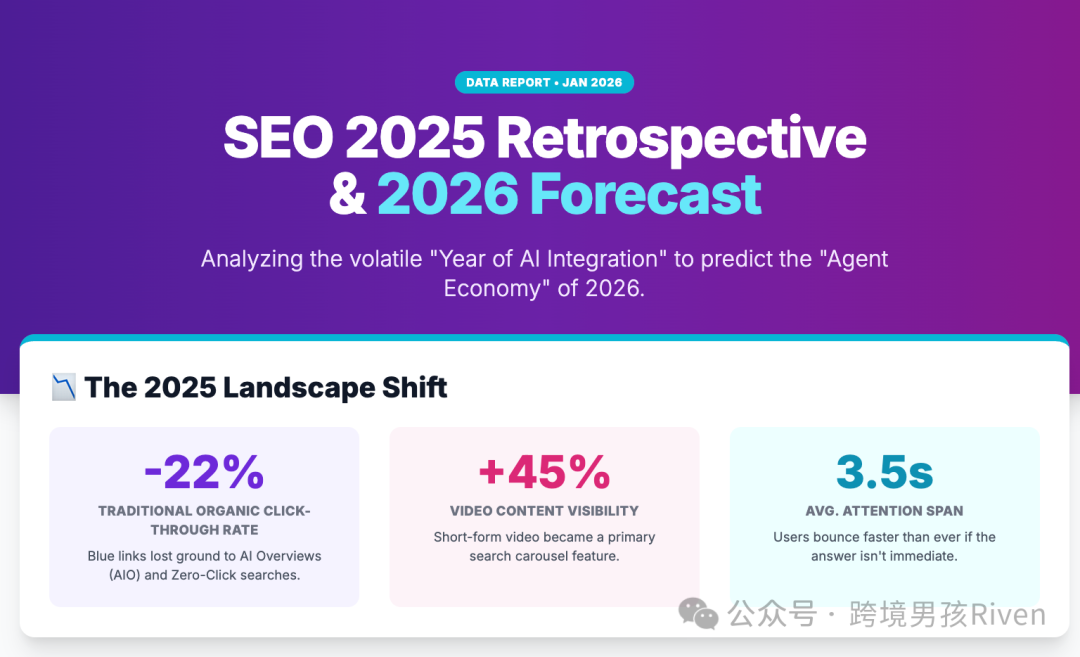
AI Overviews have created a severe "siphoning effect" on traditional ranking positions. A September study by Seer Interactive pointed out that in SERPs where AIO appeared, organic CTR plummeted by 61%, and paid ad CTR dropped by 68%. For non-branded informational queries, AI summaries almost completely replaced the user's need to click through to a website.
However, within this negative impact lies a "Citation Dividend." Research found that while overall CTR dropped, brands that were directly cited and linked within the AI Overview saw organic click volumes 35% higher than brands in the top 10 that were not cited. Furthermore, the traffic from citations demonstrated higher conversion rates and stronger intent, compelling SEO practitioners to shift their strategic focus from "fighting for Rank 1" to "fighting for an AI Summary citation slot."
2.3 Differentiated Industry Penetration
Sectors such as Science, Computer Electronics, and Law/Government have become the "frontline" for AI Overviews, with coverage rates reaching as high as 17% to 26%. These industries typically have knowledge structures with strong consensus, making them easy for AI to consolidate. In contrast, due to extremely high requirements for real-time accuracy, AIO growth in News and Sports remains relatively slow.
Google research table
3. The Evolution of E-E-A-T: From "Looking Professional" to "Verifiable Reality"
Google research
In 2025, Google's assessment of content evolved from simple semantic analysis to deep tracing of content producers and their backgrounds. The Search Quality Rater Guidelines (QRG) updates in January and September 2025 provided clear policy directives: the system must be able to identify and filter "Fake E-E-A-T" content.
3.1 Classification of AI Content & Definition of Abuse
Google explicitly defined in the guidelines that Generative AI is an "assistive tool" for content creation, not a "replacement." The guidelines state that if a page's Main Content (MC) is generated entirely by AI and lacks human editing, original research, or unique value, it should be given a "Lowest Quality" rating.
The 2025 assessment standards added a key point: the system began scanning for "AI fingerprints," such as typical phrasing like "As an AI language model..." or superficial summaries lacking evidence of field investigation. This marks a shift in SEO strategy from "AI mass production" to a symbiotic mode of "AI Framework + Human Expert Incremental Content."
3.2 Increased Weight of "Experience" & Visual Evidence
Among the four dimensions of E-E-A-T, "Experience" was given extremely high priority in 2025. Google publicly emphasized that the system prefers to reward content that demonstrates "first-hand experience." For example, in product reviews, text alone is insufficient; it must include original product photos, hands-on videos, or personal case studies containing environmental context.
Data observations from the December Core Update further support this: websites in YMYL fields (such as health, finance, election info) that provided multi-channel expert endorsements (like LinkedIn links, external media interviews, award certifications) saw significant improvements in CTR and average ranking.
3.3 Crackdown on Fake E-E-A-T & Deceptive Intent
The January 2025 QRG update added section 4.5.3, specifically targeting "Deceptive E-E-A-T" content. This includes using AI-generated fake avatars, fabricated professional resumes, or fake physical store addresses. Google considers these behaviors to have deceptive intent, and penalties are no longer limited to ranking drops but involve automated trust downgrades via core algorithms. This trend indicates that SEO in 2026 will rely more on authentic PR activities and Social Proof, rather than closed-off on-site optimization.
4. The Fundamental Restructuring of Technical SEO: Anti-Crawling & Benchmark Adjustments
The field of Technical SEO underwent a "quiet revolution" in 2025. To maintain the defensibility of its search ecosystem, Google made multiple major adjustments to crawling mechanisms and data reporting systems.
4.1 The Deprecation of &num=100 & The Paradigm Shift in Rank Tracking
On September 10, 2025, Google ended support for the long-standing &num=100 search parameter. This change was catastrophic for the SEO industry. For a long time, SEO tools (like Ahrefs, Semrush) used this parameter to scrape 100 results at once to calculate rankings; now, they must initiate 10 times the requests to acquire the same data, vastly increasing monitoring costs.
On a deeper level, this move was designed to combat large-scale AI crawlers and lock the focus of search result presentation to the "human-visible top 10." Consequently, Impressions in Google Search Console saw an industry-wide plunge in September. This did not represent a loss of real traffic, but rather the squeezing out of statistical inflation caused by bot crawling. SEO teams must now establish more realistic data baselines.
In 2025, Google began mandating JavaScript execution for certain search services. This means content consumption tools and legacy LLM crawlers unable to process dynamic scripts cannot read search result pages. For webmasters, this re-established Core Web Vitals as the threshold in the AI search era.
If a website's LCP (Largest Contentful Paint) time is too long, or if an infinite loop occurs during JavaScript rendering, AI Overviews will be unable to extract its content as a summary source. Therefore, the focus of Technical SEO in 2025 shifted from simple "Crawlability" to "Rendering Efficiency" and "Content Extractability."
4.3 Architectural Evolution of Google Search Console: Query Groups
Google research
To help high-traffic sites better cope with AI-induced volatility, Google introduced the AI-driven "Query Groups" feature in Search Console. This feature automatically categorizes thousands of long-tail keywords into "User Intent Clusters." SEO professionals can now evaluate performance starting from macro intent categories (e.g., "Research Intent" vs. "Transactional Intent") rather than obsessing over fluctuations of single keywords. This marks the official entry of SEO into the era of "Intent Management."
Google research table
5. Deep Evolution of Commercial, Multimodal & Verticals
Google Search in 2025 is no longer a flat list of text, but a highly integrated multimedia response platform, especially in e-commerce and location-based services.
5.1 Structured Competition in E-commerce
In 2025, Google launched new structured data support for shipping and return policies. Merchants can now display delivery times, shipping cost estimates, and return windows directly in search results. This effectively moves traditional Product Detail Page (PDP) functionality to the Search Engine Results Page (SERP). Data shows that merchants using this structured data saw an average conversion rate increase of 28%, as users completed risk assessment before clicking through to the site.
5.2 Multimodal Search & The Video-First Trend
With the integration of Gemini 3 Flash/Pro models, AI Overviews began to possess stronger multimodal processing capabilities. A significant update in June specifically adjusted rankings for "Explicit Video Content": if Googlebot cannot properly crawl video files within a webpage, the page's ranking in video mode is severely restricted.
Experts predict that by 2026, the status of YouTube videos in search results will further rise, especially for "How-to" and review queries. Video is no longer supplementary material but a core form of evidence satisfying E-E-A-T requirements. Research shows that in search results containing AI summaries, the proportion citing video content is increasing at a rate of 5% per month.
5.3 Glitches & Outages: Fragility of Infrastructure
2025 also recorded several major technical glitches, revealing the instability of search infrastructure during this transition period.
October Data Center Incident: From October 3rd to 6th, Google Search experienced partial service interruptions due to data center failures, affecting page displays in certain regions. Google officially advised SEO professionals not to make any aggressive site changes during this period, as traffic fluctuations were entirely due to infrastructure issues.
August Reporting Delay: On August 24th and 25th, Search Console experienced massive data delays and reporting failures, causing impression and click data for some sites to drop by 80%. This event served as a reminder that practitioners must possess third-party tracking tools like GA4 or Microsoft Clarity to distinguish between algorithm updates and system failures.
6. Insight into 2026: 5 Strategic Pillars & Future Outlook
Through a review of 2025 data, we can clearly define the core tasks for SEO in 2026. 2026 will no longer be about "Rank," but about "Presence" and "Influence."
1. From SEO to GEO: Generative Engine Optimization
The primary operational focus for 2026 will be Generative Engine Optimization (GEO). This requires content to not only have ranking capability but also "Extractability."
Application of the CSQAF Framework: Citations, Statistics, Quotations, Authoritativeness, and Fluency will become the gold standard for content production.
Micro-intent Capture: AI will dig deeper into the patterns behind search behavior. SEO needs to cover all micro-intent stages of a user's journey, from initial curiosity to final decision, via "Content Clusters."
2. Brand Mentions Replace Backlinks
In the era of large AI models, the frequency of brand mentions and contextual co-occurrence may be more important than traditional backlinks.
If an LLM repeatedly sees a brand associated with "best cloud service" or "professional medical advice" in its training data, the probability of that brand being cited when generating answers increases drastically. Therefore, PR activities, community engagement (e.g., Reddit, industry forums), and cross-platform brand consistency will become core SEO work in 2026.
3. Comprehensive Deepening of "Pillar-Cluster" Semantic Architecture
With the maturation of deep semantic retrieval algorithms like MUVERA, the optimization of isolated pages has lost its meaning. Successful websites in 2026 will organize content like an "Encyclopedia":
Depth Over Breadth: Establishing absolute Topical Authority in a small, refined niche is more conducive to gaining AI favor than dabbling superficially in a broad field.
Entity Clarity: Ensure your company, products, and authors have clear entity definitions in the Knowledge Graph, including unique associations established through Organization Schema and personal homepages.
4. Share of SERP as KPI
The traditional "Number 1 Ranking" metric has become obsolete. In 2026, SEO teams should monitor their occupancy rate across various SERP features:
AI Overviews Citation Rate: How frequently does your site appear in AI answers?
PAA (People Also Ask) Coverage: Are you answering the follow-up questions users care about most?
Multi-Platform Visibility: Can users see the same expert advice from you on YouTube, TikTok, and Google Search?
5. Business Model Transformation for "Zero-Click"
As informational queries become completely monopolized by AI summaries, websites relying purely on traffic monetization (like display ads) will face an existential crisis.
Shift to Deep Conversion: SEO in 2026 will focus more on high-quality conversions. Although overall click volume may drop, traffic from AI citations has clearer intent.
Building Private Assets: Search traffic will become more volatile. Using SEO to guide users to sign up for Newsletters or download Apps will be an inevitable choice to hedge against Google algorithm risks.
7. Conclusion: Reshaping SEO Logic for 2026
Google research
The series of core algorithm updates, technical fractures, and policy revisions in 2025 collectively herald the arrival of a new search era: a process shifting from "Manipulating Algorithms" to "Building Trust."
For Core Updates: Do not try to find a "magic pill." Data from 2025 proves that the best recovery strategy is to systematically improve E-E-A-T, especially by reinforcing the core dimension of "Trust" through real, verifiable expert backgrounds.
For Generative AI: Embrace GEO. Structure your content to make it the best source material for AI to answer questions. Use concise summaries of 50-70 words as openers for every topic to attract machine extraction.
For Technical Challenges: Focus on efficiency and benchmarks. With &num=100 gone, establish a monitoring system centered on real user interaction, ensuring JavaScript rendering paths are smooth and create no obstacles for AI information extraction.
In 2026, the identity of SEO practitioners will transform into "Brand Intent Architects." They must manage not only code and keywords but also the brand's digital reputation across the entire generative ecosystem.
Although the form of search results is changing, Google's core mission—connecting users with the most valuable information—remains unchanged.
Websites that survive and thrive will be authoritative entities capable of providing real experiences, possessing unique perspectives, and being efficiently parsed by generative systems.