Ask ChatGPT for "a wedding photographer in Austin with a documentary style" or "where to buy fine-art coastal prints," and it answers with names — a short list assembled before the person opens Google or Instagram. If your portfolio and print shop live on Pixpa, a growing share of your discovery now happens inside that answer, and most photographers and designers have no way to check whether they made the cut.
That is the visibility you can't see. Your site analytics count the visits that already happened; they say nothing about the AI answers deciding whose portfolio gets recommended in the first place. GEO (Generative Engine Optimization) and AEO (Answer Engine Optimization) tools exist to close that gap.
This guide ranks the GEO/AEO tools that genuinely fit Pixpa brands in 2026 and explains how to choose. For a creative business the number to anchor on isn't your keyword ranking — it's your share of AI answers and citations: AI Generative Visibility Rate (AIGVR), Share of Voice, and Citation Rate. If you sell prints or products, Share-of-Card matters too.
Key takeaways
GEOly AI is the best fit for Pixpa brands because it tracks whether AI engines cite and recommend you across ChatGPT, Gemini and Perplexity — and, for creatives who sell prints, it measures Share-of-Card at the product level, which brand-only tools can't.
Pixpa is a portfolio-first platform, so most of your GEO win comes from brand and content visibility: being the name an AI names when someone asks for a photographer, designer or artist in your niche.
Pixpa gives you indexable pages, a blog and standard SEO controls, so your gap is measurement and action — seeing which of your pages get cited, and why a competitor gets recommended instead.
Profound and Scrunch lead on enterprise breadth, Peec AI is a strong modern generalist, and Otterly and Rankscale win on price — but all track brand mentions without the commerce layer for those who also sell.
Start with a free audit of what AI engines already say about your name and studio before you buy any tool.
Why Pixpa brands need a GEO/AEO tool in 2026
Pixpa is built for creatives — photographers, designers and artists running portfolios, client galleries, a blog and, often, a small store selling prints or services. That makes your GEO problem different from a big-catalog retailer's. For most Pixpa users, the win isn't dominating a thousand product cards; it's being the name an AI recommends when a prospective client asks for someone in your specialty and city. Discovery for creative work is increasingly a conversation with an assistant, and the assistant surfaces a handful of names — you want to be one of them.
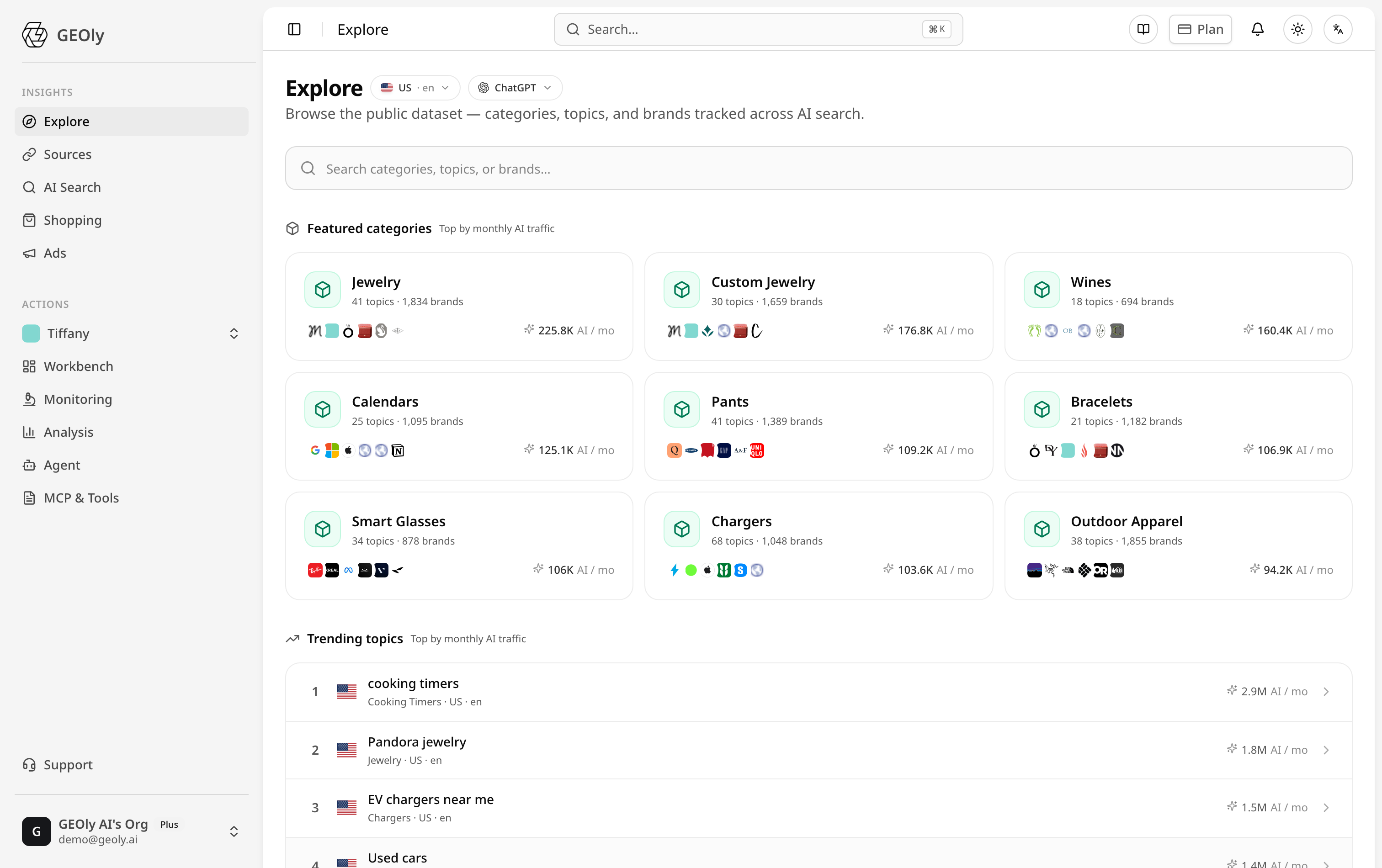
GEOly Explore: AI industry intelligence across categories, topics and brands with monthly AI traffic — source: app.geoly.ai
Here is the catch. Pixpa gives you SEO-friendly, indexable pages and a blog, which is the necessary foundation. But indexable is not the same as cited. An AI engine builds its answer from portfolios it can read and trust — clear text about your style, location, services and clients, structured so a model can lift it. A gallery of beautiful images with almost no descriptive text is easy for a human to admire and hard for an AI to recommend, and no dashboard tells you whether it's happening. If you also sell prints, that same gap shows up at the product level as agentic shopping tools roll out — but for most Pixpa creatives the first, biggest prize is simply being cited.
How we picked the best GEO/AEO tool for Pixpa
Five criteria, weighted for a creative portfolio and small print store rather than an enterprise:
Engine coverage — does it monitor ChatGPT, Gemini, Google AI Mode, Perplexity, Copilot and Grok, not just one?
Citation and brand-level tracking — can it show which of your pages get cited and where you appear in answers, not just an abstract score?
Commerce readiness for those who sell — if you offer prints or products, does it measure Share-of-Card, or stop at brand mentions?
Platform-native fit — does it map onto how a portfolio-first Pixpa site and its content actually work?
Reporting and price-to-value — actionable output at a price a solo creative or small studio can justify.
The best GEO/AEO tools for Pixpa brands in 2026
1. GEOly AI
GEOly is built for exactly the gap a portfolio platform leaves open. Pixpa makes your work look right; GEOly tells you whether AI engines actually cite and recommend it — and what to change when they don't. For creatives who also sell, it's the one tool here that reaches down to the product and shopping-card level too.
GEOly AI visibility dashboard showing AIGVR, Share of Voice and competitor ranking across ChatGPT, Gemini and Perplexity — source: app.geoly.ai
Start with brand visibility tracking: GEOly reports your AIGVR and Share of Voice across ChatGPT, Gemini, Google AI Mode, Perplexity, Grok and Copilot, plus Share of Model per engine, so you see where your name appears and where a competing studio owns the answer. AI Citation analysis shows which of your pages AI engines actually cite — the difference between being read and being recommended. Query Fan-out surfaces the real questions prospective clients ask an AI on the way to hiring or buying — the Demand Themes your portfolio copy and blog should answer.
If your Pixpa store sells prints or products, GEOly adds a layer general GEO tools don't have. Its AI Shopping Monitoring tracks your Share-of-Card — the share of AI-generated shopping cards your products win — and shows how individual items rank for real buyer prompts.
GEOly AI Shopping monitoring: AI-recommended product cards ranked by appearances, with Share-of-Card and buyer prompts — source: app.geoly.ai
The broader e-commerce brands solution ties AI visibility back to real inquiries and orders through GA4, so you measure business impact, not vanity mentions. A 29-point GEO Audit gives you a concrete starting checklist — especially useful on a portfolio site where descriptive text and structure decide whether a model can cite you. See the full picture on the Pixpa GEO page.
Strengths at a glance: - 実際に推奨されているかどうかを確認する引用およびページレベルのトラッキング、さらに販売している場合は製品レベルのShare-of-Card。 - フルエンジン対応: ChatGPT、Gemini、Google AI Mode、Perplexity、Grok、Copilot。 - AIの可視性を単なる言及ではなく、実際の問い合わせや注文に結び付けます。 - 最適な対象: Pixpaを使用する写真家、デザイナー、アーティストで、AIが推奨する名前になりたい方。
Profound はエンタープライズAEOのリーダーであり、10以上のエンジンにわたる可視性、引用、感情、Share of Voiceをトラッキングし、ブランドについてAIがどのように話しているかを掘り下げるConversation Explorerを提供します。洗練されていて幅広い機能を持っていますが、大規模ブランド向けに価格設定されており構築されています(セルフサーブは約$99/月、Growthは$399、エンタープライズは数千ドルに達します)。個人クリエイターや小規模スタジオには、必要以上のプラットフォームと費用です。
最適な対象: ブランドレベルのAI評判を追跡するエンタープライズマーケティングチーム。
3. Peec AI
Peec AI はクリーンでモダンな中規模市場向けGEO分析ツールです—可視性、平均ポジション、引用シェア、感情、競合ベンチマーキング、MCPサポート、無制限のユーザーを提供し、$95(スターター)から$245(プロ)、$495(アドバンス)までの価格帯です。ブランドレベルのモニタリングには強力なジェネラリストであり、公正な選択肢です。ただし、コマースレイヤーがないため、プリントを販売している場合、製品レベルの回答シェアを測定することはできません。