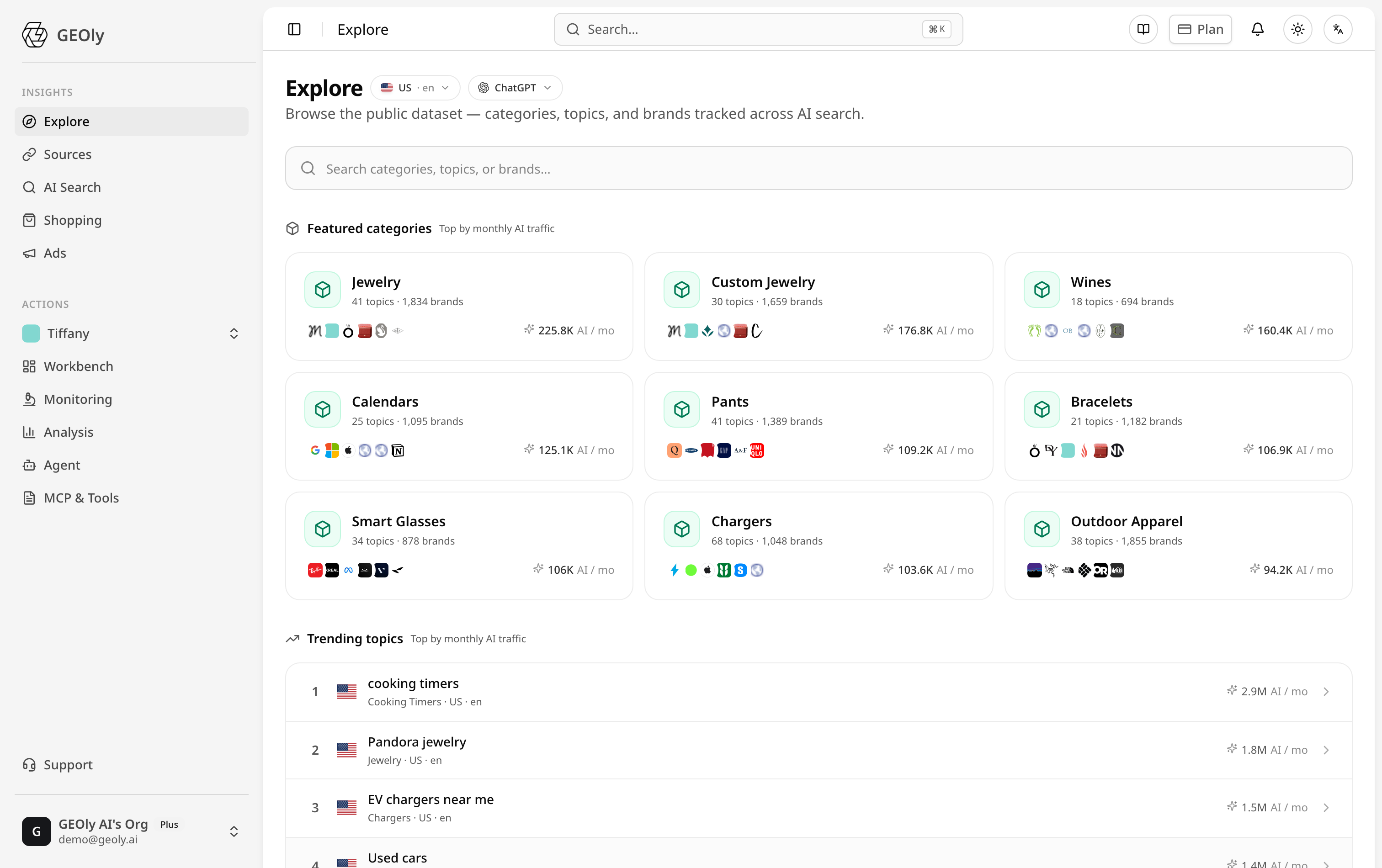
基本から始めましょう。GEOlyのブランド可視性追跡は、ChatGPT、Gemini、Google AI Mode、Perplexity、Grok、Copilot全体でのAIGVRとShare of Voiceを報告し、AI回答があなたの名前を挙げているか、それとも他の誰かを挙げているかをついに確認できます。そのAI citation analysis tracks your Citation Rate — how often engines actually link to or quote your blog and pages — which for a content-and-list brand is the closest thing to a scoreboard.
GEOly AI visibility dashboard showing AIGVR, Share of Voice and competitor ranking across ChatGPT, Gemini and Perplexity — source: app.geoly.ai
From there, GEOly turns visibility into action. The GEO Audit is a 29-point check that shows exactly how to frame your site and articles — headings, descriptions, structure, entity clarity — so AI engines understand who you are and what you publish. That is the practical follow-through to MailerLite's clean publishing: MailerLite gets the pages live, GEOly tells you why they are or aren't being cited. The track AI brand mentions solution ties it together for a brand whose goal is recommendation and signups, not a shopping cart.
Two more pieces fit the MailerLite profile. GEOly's Brand Knowledge Graph helps AI engines resolve who you are as an entity — critical when your identity is a newsletter and a name rather than a big catalog. And Query Fan-out surfaces the real questions your audience asks AI, so you can write your next blog post and landing page to answer them directly. The honest caveat: GEOly's deepest native integration is Shopify and its AI-shopping features are built for stores, so a MailerLite brand uses the visibility, citation, and audit side rather than Share-of-Card — which is the right toolkit for a content-and-list brand anyway.
GEOly Query Fan-out: the real web-search queries ChatGPT runs for a category, grouped into demand themes — source: app.geoly.ai
2. Otterly.ai
Otterly.ai is the budget entry point, starting at $29 for its Lite plan. It handles prompt research, a brand visibility index, and citation tracking across ChatGPT, AI Overviews, Perplexity, Gemini, and Copilot, with MCP and API access, per its pricing page. For a solo creator testing the waters, it's a low-commitment first read.
Best for: solo makers and small brands who want a cheap first look at AI visibility.
Weaker for a MailerLite brand: it's a light generalist with no deeper audit or knowledge-graph layer to help you fix your content.
3. Peec AI
Peec AI is a modern, well-designed mid-market GEO platform covering visibility, average position, citation share, sentiment, and competitor benchmarking, with MCP support and unlimited users. Plans are Starter $95, Pro $245, and Advanced $495, per its pricing page. Its clean design suits a brand-conscious marketing team.
Best for: growing teams that want a polished generalist GEO tool with room for many users.
Weaker for a MailerLite brand: it's built and priced for a team, which overshoots a one-person or small newsletter brand.
4. Profound
Profound is the enterprise AEO leader. It tracks visibility, citations, sentiment, and Share of Voice across 10+ engines, and its Conversation Explorer is strong for understanding how AI talks about a category. Pricing runs from around $99/mo self-serve to a $399 Growth tier and $2k–5k+ for enterprise, per its pricing page.
Best for: larger brands that need broad, cross-industry AEO coverage.
Weaker for a MailerLite brand: it's enterprise-scale in both features and price, far more than a creator's site and list need.
5. Semrush AI Visibility Toolkit
Semrush bolts AI visibility onto its established SEO suite, at $99/mo per domain for the AI Toolkit, per this review. If you already run your blog's SEO in Semrush, it's a convenient add-on.
Best for: people already paying for Semrush who want AI visibility in the same dashboard.
Weaker for a MailerLite brand: it's SEO-first and heavier than a small content site warrants, without commerce or citation focus for a single brand.
MailerLite-specific GEO checklist
Treat your blog as your primary AEO asset: give each post a clear, plain-language H1 and section headings that answer a real question, because that text is what AI engines lift into answers.
Connect a custom domain so your brand reads as a real entity, not a subdomain, to AI engines and knowledge graphs.
Write landing pages and posts around the actual questions your audience asks AI — "best newsletter for X," "how do I Y" — rather than vague taglines; use Query Fan-out to find those questions.
Add structured data (Person, Organization, Article, or Product for digital goods) so AI agents can parse who and what you are.
Keep key pages and posts crawlable, and consider an llms.txt file so AI engines can reach your content.
Build a few real third-party mentions — a Reddit thread, a directory listing, a guest post — since AI answers lean on external citations to decide who to recommend.
Yes, if AI search sends you subscribers or buyers. MailerLite publishes clean, readable sites and blogs, but it doesn't measure anything — so a GEO/AEO tool is the only way to know whether ChatGPT or Perplexity recommends you and cites your content.
Is GEOly better than Profound for a MailerLite site?
For a solo or small-team brand, yes. Profound is excellent enterprise AEO, but GEOly's citation tracking, Brand Knowledge Graph, and 29-point audit map to a content-and-list brand far better than an enterprise-priced platform does.
Does AI shopping (Share-of-Card) matter for MailerLite?
Usually not much. MailerLite lacks a full product-order-payment loop, so agentic shopping mostly doesn't apply. Your goal is being cited and recommended by name — which GEOly tracks directly, without needing a store.
What's the cheapest way to start?
Otterly.ai at $29 gives you a basic visibility read. As AI-driven interest grows, move to GEOly for the citation tracking and audit that actually tell you how to improve your content — a GEO Audit shows precisely what to change.