このガイドでは、2026年にFramerサイトに実際に適合するGEO/AEOツールをランク付けし、選び方を説明します。基準となる指標はAI生成可視性率(AIGVR)です。これは、AIエンジンがどのくらいの頻度で、どの程度目立つ形であなたを表示するかを示します。また、Share of Voiceや、販売を行う場合はShare-of-Cardも考慮します。より深いプラットフォームの視点については、「Framer GEO」ページをご覧ください。
基本から始めましょう。GEOlyの「ブランド可視性追跡」は、ChatGPT、Gemini、Google AI Mode、Perplexity、Grok、Copilot全体でのAIGVRとShare of Voiceを報告します。これにより、AI回答があなたを名前で挙げているのか、それとも競合他社を挙げているのかをついに確認できます。「競合分析」ビューは、それをあなたのニッチにおけるShare of Modelリーダーボードに変換します—AIがデフォルトで誰を選ぶのかを理解しようとする小規模ブランドにとって有用です。
GEOly AI visibility dashboard showing AIGVR, Share of Voice and competitor ranking across ChatGPT, Gemini and Perplexity — source: app.geoly.ai
GEOlyが一般的なツールと差別化されるのは「AIショッピングモニタリング. It tracks your Share-of-Card — how often your products appear in the ranked cards AI assistants show for buyer prompts like "best minimalist standing desk under $500" — a metric general GEO tools don't have, because they don't hold a shopping dataset. For a lean Framer catalog, that maps directly to whether an AI-assisted shopper ever sees the one product that matters.
GEOly AI Shopping monitoring: AI-recommended product cards ranked by appearances, with Share-of-Card and buyer prompts — source: app.geoly.ai
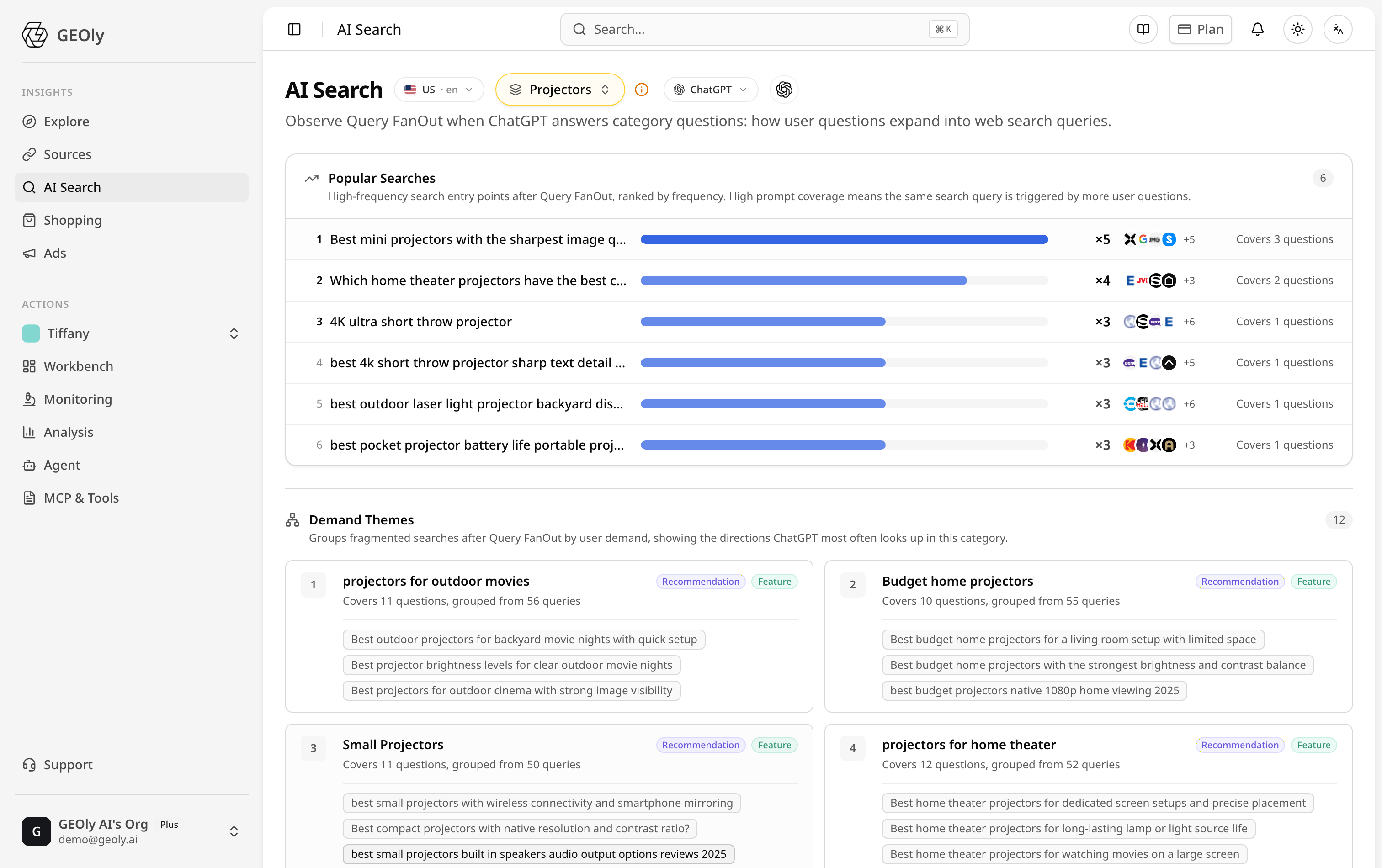
Two more pieces fit the Framer profile. The GEO Audit is a 29-point check that shows exactly how to frame your Framer product content — headings, descriptions, structure, llms.txt — so AI engines evaluate it correctly, the practical follow-through to Framer's own llms.txt support. And Query Fan-out surfaces the real buyer questions and Demand Themes your pages should answer, high-leverage when every page has to earn its place. GEOly ties visibility to real outcomes through GA4 and other integrations, and it's timed for Agentic Commerce; the ecommerce brands solution page shows how it fits a small catalog. The honest caveat: GEOly's deepest native integration is Shopify, so Framer merchants lean on schema, content, and connector workflows rather than a one-click app — which suits Framer's build-it-your-way ethos.
2. Peec AI
Peec AI is a modern, well-designed mid-market GEO platform covering visibility, average position, citation share, sentiment, and competitor benchmarking, with MCP support and unlimited users. Plans are Starter $95, Pro $245, and Advanced $495, per its pricing page. Its clean, European design sensibility makes it a natural fit for the kind of team that also chose Framer.
Best for: growing design and startup teams that want a polished generalist GEO tool with room for many users.
Weaker for a Framer brand: it's brand-level analytics, not product-level or Share-of-Card, so it won't tell a lean catalog which item wins the shopping answer.
3. Otterly.ai
Otterly.ai is the budget entry point, starting at $29 for its Lite plan. It handles prompt research, a brand visibility index, and citation tracking across ChatGPT, AI Overviews, Perplexity, Gemini, and Copilot, with MCP and API access, per its pricing page. For a solo designer or early startup, it's a low-commitment first look.
Best for: solo founders and creators who want a first read on AI visibility without a big commitment.
Weaker for a Framer brand: it's shallow on commerce, with no product-level or AI-shopping-card measurement.
4. Profound
Profound is the enterprise AEO leader. It tracks visibility, citations, sentiment, and Share of Voice across 10+ engines, and its Conversation Explorer is genuinely strong for understanding how AI talks about a category. Pricing runs from around $99/mo self-serve to a $399 Growth tier and $2k–5k+ for enterprise, per its pricing page.
Best for: larger brands that need broad, cross-industry AEO coverage.
Weaker for a Framer brand: it measures brand-level visibility, not product/SKU or AI-shopping-card presence, and the pricing overshoots most startups and creators.
Framer-specific GEO checklist
Add and maintain your llms.txt file so AI agents can read and understand the products behind your site.
Frame each product page around a buyer question — what it is, who it's for, how it compares, what it costs — because that plain-language text is what gets lifted into AI answers.
Add Product and Offer structured data via Framer's custom code or a structured-data embed, including price and availability, so agents can parse your catalog.
Keep your strongest product on its own crawlable page with a clear H2 and descriptive copy; if products live through an external integration, expose that data on a crawlable page, not locked inside a widget AI engines can't read.
Gather and display real reviews and third-party mentions; AI shopping answers lean on social proof from sources like Reddit and YouTube.
Track your Share-of-Card and AIGVR for your top products with AI shopping monitoring, then fix the specific gaps a GEO Audit flags.
FAQ
Do I need a GEO tool if I'm on Framer?
Yes, if AI search sends you customers. Framer gives you strong LLM-readiness and llms.txt support but no visibility measurement, so a GEO/AEO tool is the only way to know whether ChatGPT or Perplexity recommends you or a competitor.
Is GEOly better than Profound for a Framer site?
For a lean, design-led catalog, yes. Profound is superb at enterprise brand-level AEO, but GEOly tracks at the product and AI-shopping-card level with its Share-of-Card metric, which is what decides sales when your catalog is small.
Is Framer ready for AI and agentic commerce?
Partly. Framer is ahead on AI publishing — it supports llms.txt and AI site building — but it's a design-first platform, not a native agentic-commerce backend, so products beyond a small catalog usually run through an integration, and it won't report how you perform inside AI answers.
What's the cheapest way to start?
Otterly.ai at $29 gives you a basic visibility read. As AI-driven sales grow, move to a commerce-native tool that measures product-level Share-of-Card. With a tiny catalog that shift matters most: each product either surfaces in AI answers or it doesn't, so a GEO Audit tells you precisely which page to fix.
Framer makes your site look extraordinary; it won't tell you whether AI shoppers ever find the product behind it. In 2026 that blind spot is the difference between being the answer and being invisible. Run a free GEO Audit to see how your products show up across AI engines, and start tracking your Share-of-Card before your competitors claim the answer.