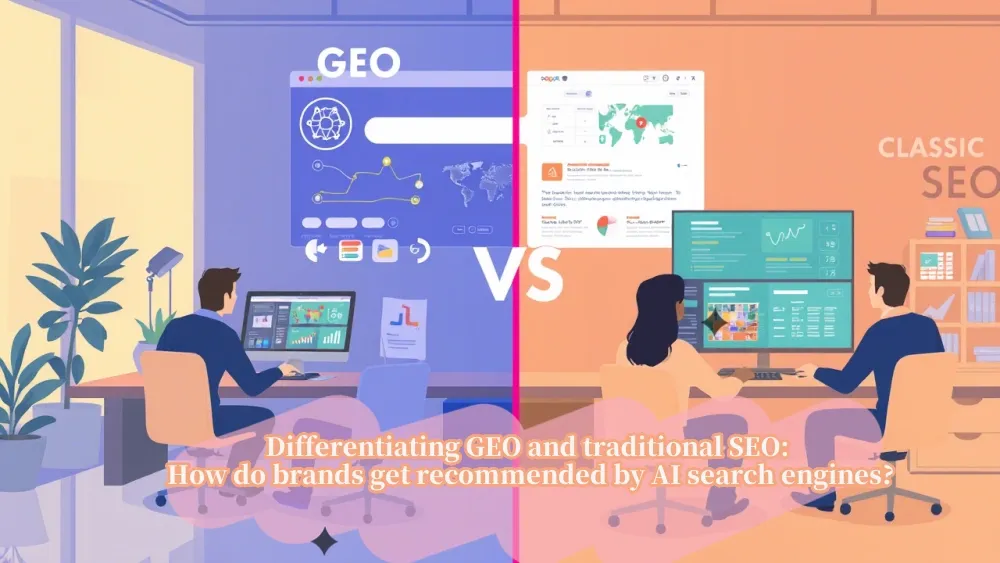
Let's be honest: the rules of search have changed.
In the past, we typed keywords into a search bar and hunted through a dozen blue links for answers. To win traffic back then, we obsessed over traditional SEO and early "AI optimization" (which mostly meant using AI to churn out keyword-stuffed articles).
But today, when people have questions, they turn to ChatGPT, Perplexity, Gemini, or Google's AI Overviews. They don't want a list of links anymore—they want direct answers.
That's exactly why Generative Engine Optimization (GEO) was born. As a GEO marketing expert, the number one question I get is: How is GEO actually different from what we've been doing?
Let's break it down in plain English.
Top 3 Differences Between GEO and Traditional Optimization
Don't let the acronyms scare you. The biggest difference is simply who we are trying to impress. We used to cater to a machine that just matched words. Now, we need to convince a "superbrain" that actually understands context.
1. The Goal: From "Chasing Clicks" to "Earning Citations"
- Traditional: Your goal was to rank #1 and write a clickbait headline to trick users into visiting your site.
- GEO: Your goal is to become the "source of truth" when AI answers a question. When large language models (LLMs) generate responses, they look for the most authoritative, relevant viewpoints and cite them. If your content is good enough, the AI will mention your brand directly in its answer—and even give you a clickable citation link.
2. Content Strategy: From "Keyword Stuffing" to "Providing Unique Value"
- Traditional: You'd pick a high-volume search term (like "best running shoes") and repeat it 10 times. Even average content could rank well.
- GEO: AI is smart. It hates fluff and repetition. GEO requires high information density, unique data, real-world case studies, or independent expert insights. If your article is just an AI-rewritten version of what's already out there, the new search engines will flat-out ignore you.
3. Formatting: From "Messy" to "Crystal Clear"
- Traditional: As long as the keywords were there and you had enough backlinks, a slightly messy layout didn't hurt much.
- GEO: AI models love structured data. Think clear H2/H3 headings, bolded key takeaways, bullet points, and straight-to-the-point summaries. This helps the AI extract your core message in milliseconds.
