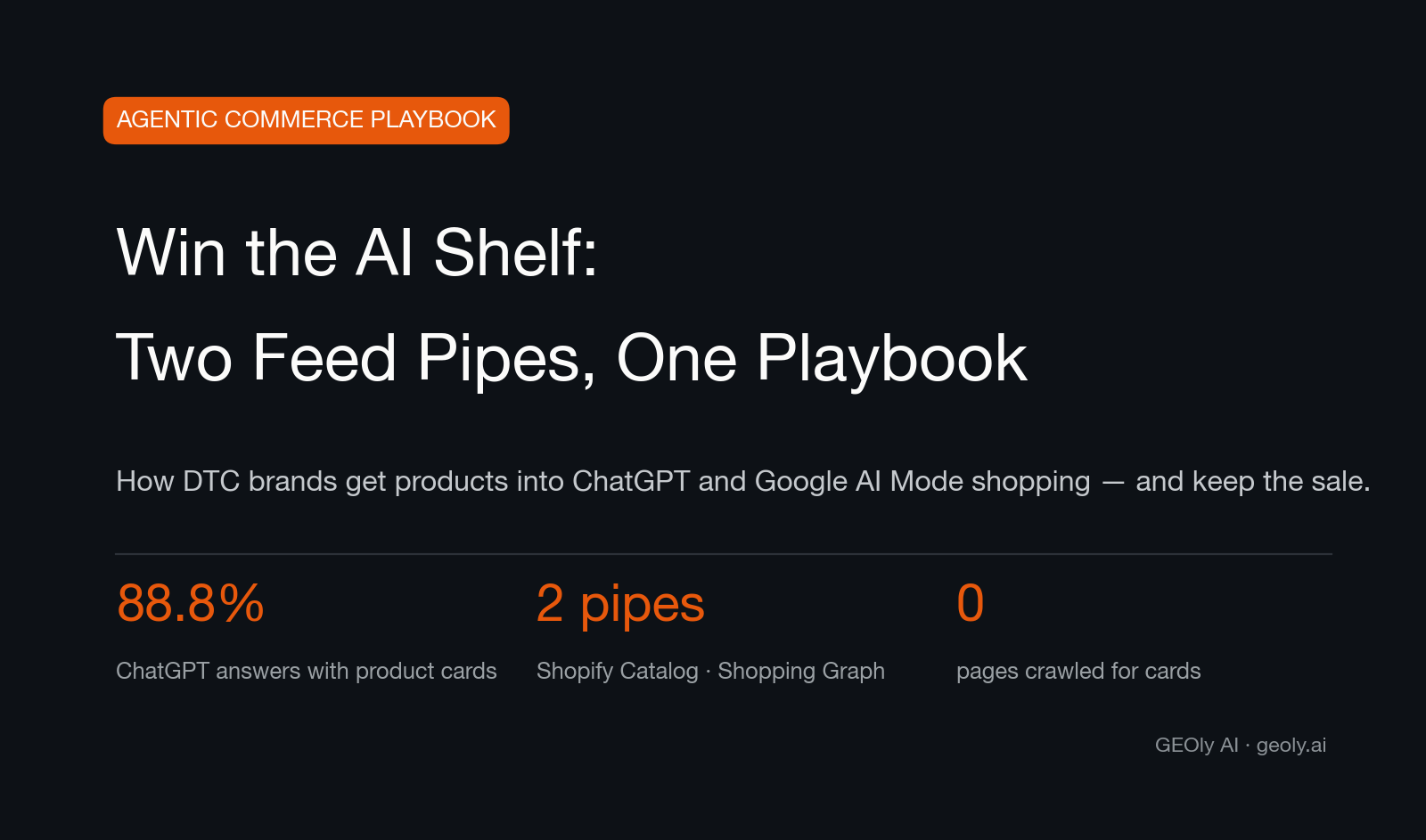
The AI shelf is already the default storefront. In shopping categories, 88.8% of ChatGPT answers and 88.4% of Google AI Mode answers surface product cards (GEOly industry monitoring, US, June 20-30, 2026). When a buyer asks an AI assistant what to buy, they don't get ten blue links. They get a shelf of cards, and either your product is on it or a competitor's is.
Here is the short answer to how you optimize for agentic commerce. The AI shelf is fed by structured catalog feeds, not by crawling your website, so the work breaks into five steps: audit your Share of Card (are your products surfacing, at what rank, against which competitors); feed both pipes by enabling Shopify's ChatGPT sales channel on OpenAI's Agentic Commerce Protocol (ACP) and keeping Google Merchant Center synced with free listings, GTIN/MPN, and live price and stock; win the offer by keeping your own-store price competitive against resellers; win the citation layer with reviews and comparison content AI engines quote next to the cards; and measure AI-driven revenue rather than mentions. The rest of this playbook walks through each step with the data behind it.
One fact reframes everything else: neither pipe reads your website. ChatGPT builds its cards from merchant catalog feeds via ACP. Google AI Mode builds them from the Shopping Graph, which is fed by Google Merchant Center (GMC). Your carefully optimized product pages are not the input. Your feed is.
Two pipes, zero overlap
We traced the link structures behind thousands of product cards to prove where each shelf gets its inventory. On ChatGPT, 100% of brand-domain product card links follow Shopify's /products/<handle>?variant=<id> pattern with utm_source=chatgpt.com attached (GEOly industry monitoring, June 2026, US). That is the fingerprint of Shopify catalogs auto-integrated into ACP. On Google AI Mode, roughly 95% of card links carry Shopping Graph identifiers instead: ibp=oshop, gpcid, catalogid. Shopify-structure links are effectively absent there, 1 out of 3,498.
Two shelves, two supply chains, no shared plumbing. Optimizing for one does nothing for the other, which is why the playbook below treats them as separate distribution channels that happen to share a screen.

Your Amazon equity doesn't transfer
Amazon is entirely absent from ChatGPT shopping. In one category we measured, zero of 10,618 offers across 239 merchants pointed to Amazon (GEOly, June 2026, US). Years of review accumulation and Best Seller badges are invisible on this shelf. That is a real problem for Amazon-first brands, and a genuine opening for DTC brands with their own storefronts and clean feeds.
You made the shelf. Someone else takes the order.
Getting surfaced is not the same as getting paid. In the audio category on ChatGPT, own-store capture rates look like this: Sony 12.8%, Bose 12.7%, Sennheiser 11.9%, Soundcore 8.8%, JBL 7.4%, Apple 7.1%, Shokz 4.0% (GEOly industry monitoring, June 2026, US). The bulk of offers route to Best Buy, Target, and Walmart instead. The AI picks whatever it judges the best available offer, and big-box retail usually has one.

