Keep your eyes on the path, but your heart on the big picture.
Hi everyone, I’m Riven.
This article is about 4,000 words. Reading time: 10 minutes. Thanks for your time.
Foreword
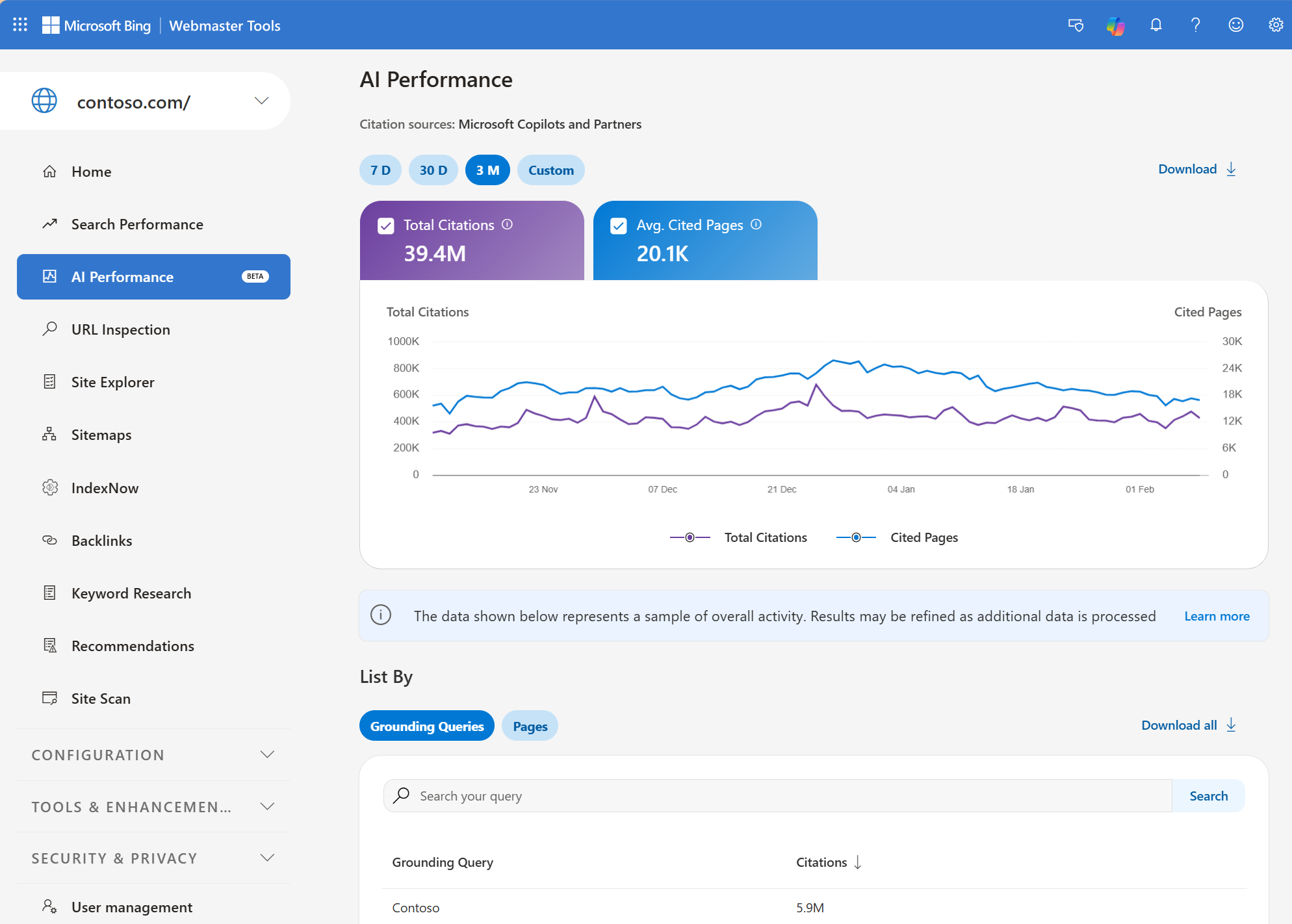
On February 10, 2026, Microsoft officially launched the public preview of the AI Performance section in Bing Webmaster Tools.
This is the first time the search industry has provided data transparency for AI citations to website owners.
As a long-time SEO professional, my first thought was: The GEO era has officially arrived.
In the past, SEO was about rankings, clicks, and impressions in Google Search Console. Now, Bing tells you exactly how many times your content was cited in AI-generated answers.
This is more than just data—it’s the definitive merger of search engines and AI engines. In this post, I’ll break down Bing AI Performance for you.
1. What Exactly is AI Performance?
1.1 The AI Experiences Covered
AI Performance tracks data across three major scenarios:
- ✅ Microsoft Copilot
- ✅ Bing AI Captions (AI answers on the search results page)
- ✅ Partner AI Integrations (Third-party AI platforms)
In short: it tracks how often your website content is used as a source when these AI systems generate an answer.
The difference between traditional SEO and GEO:
- Traditional SEO: User searches → Sees your link → Clicks to your site.
- AI Era (GEO): User searches → AI generates an answer → Your content is cited (with or without a click).
1.2 Why Launch This Now?
AI search is no longer a concept; it’s our reality:
- ChatGPT handles hundreds of millions of queries daily.
- Google SGE is live in the US.
- Perplexity and Claude are rising fast.
Microsoft realized that without providing citation data, the content ecosystem would collapse. Why would creators keep writing if they didn't know AI was using their work?
2. Deep Dive: 5 Core AI Performance Metrics
I’ve broken down these metrics into five dimensions:
2.1 Total Citations
- Definition: The total number of times your content appeared as a source in AI answers within a specific timeframe.
- This is the "Total Clicks" equivalent for GEO. Use it to track your AI visibility over time.
